Mineral Architecture
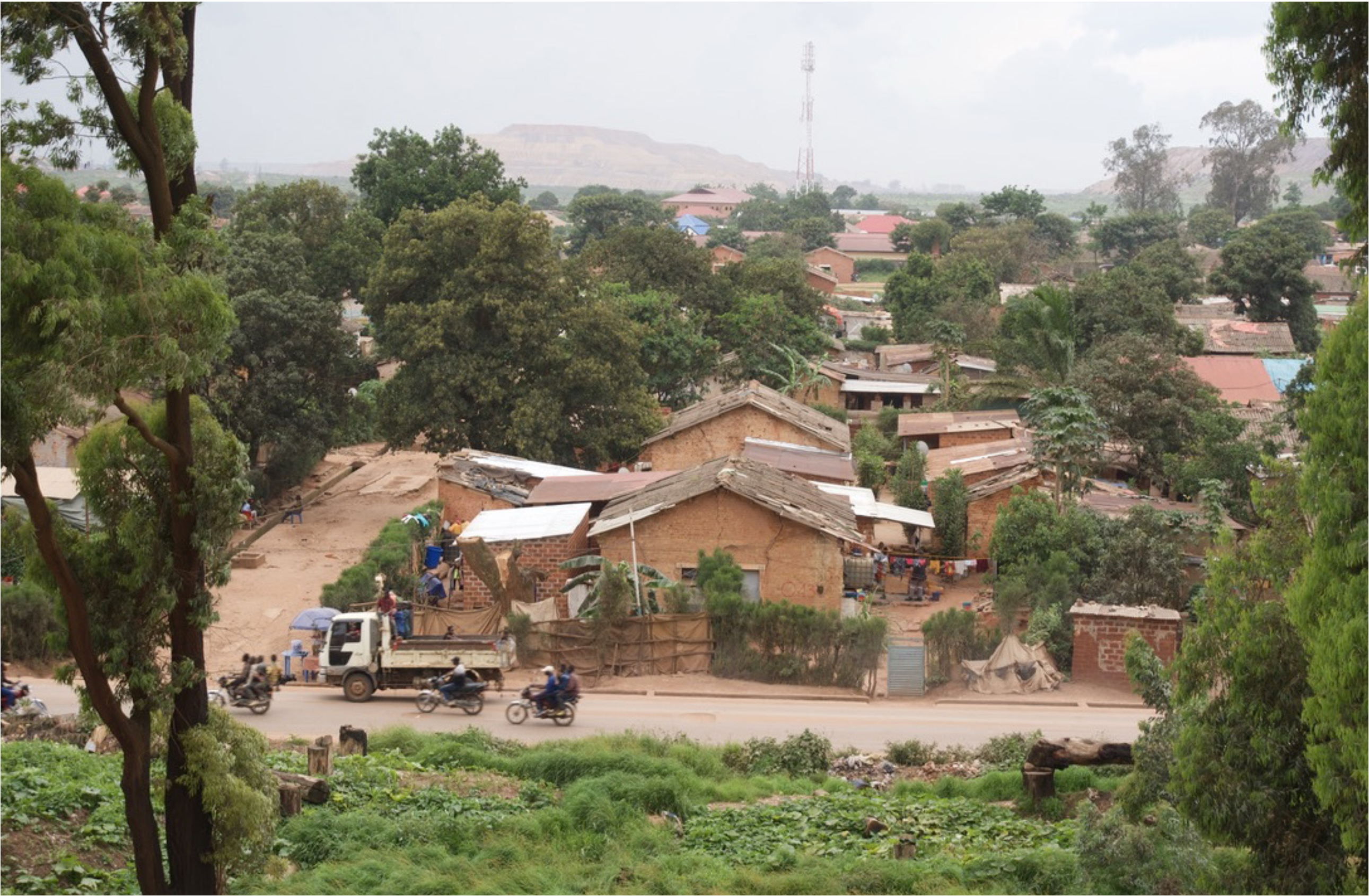
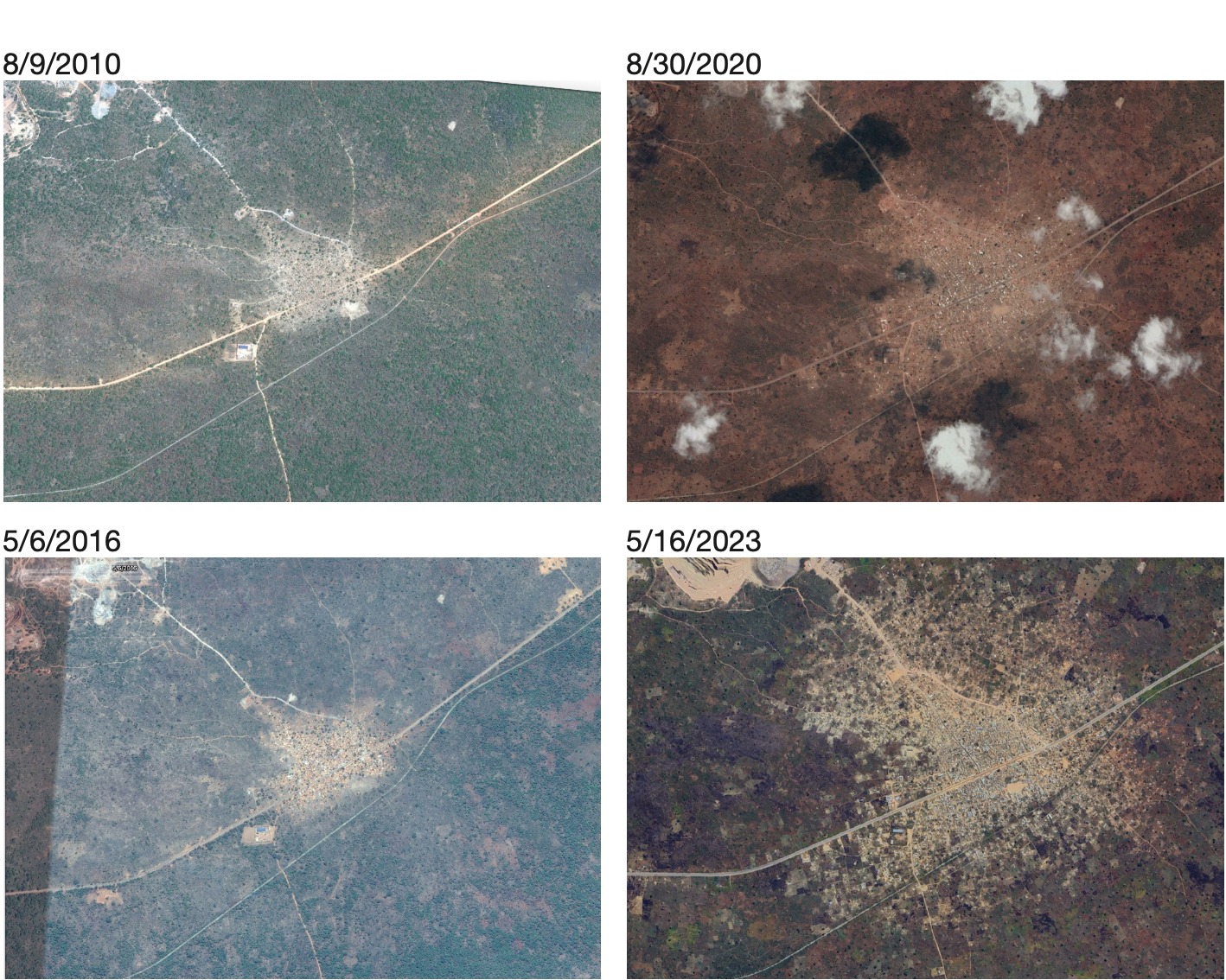
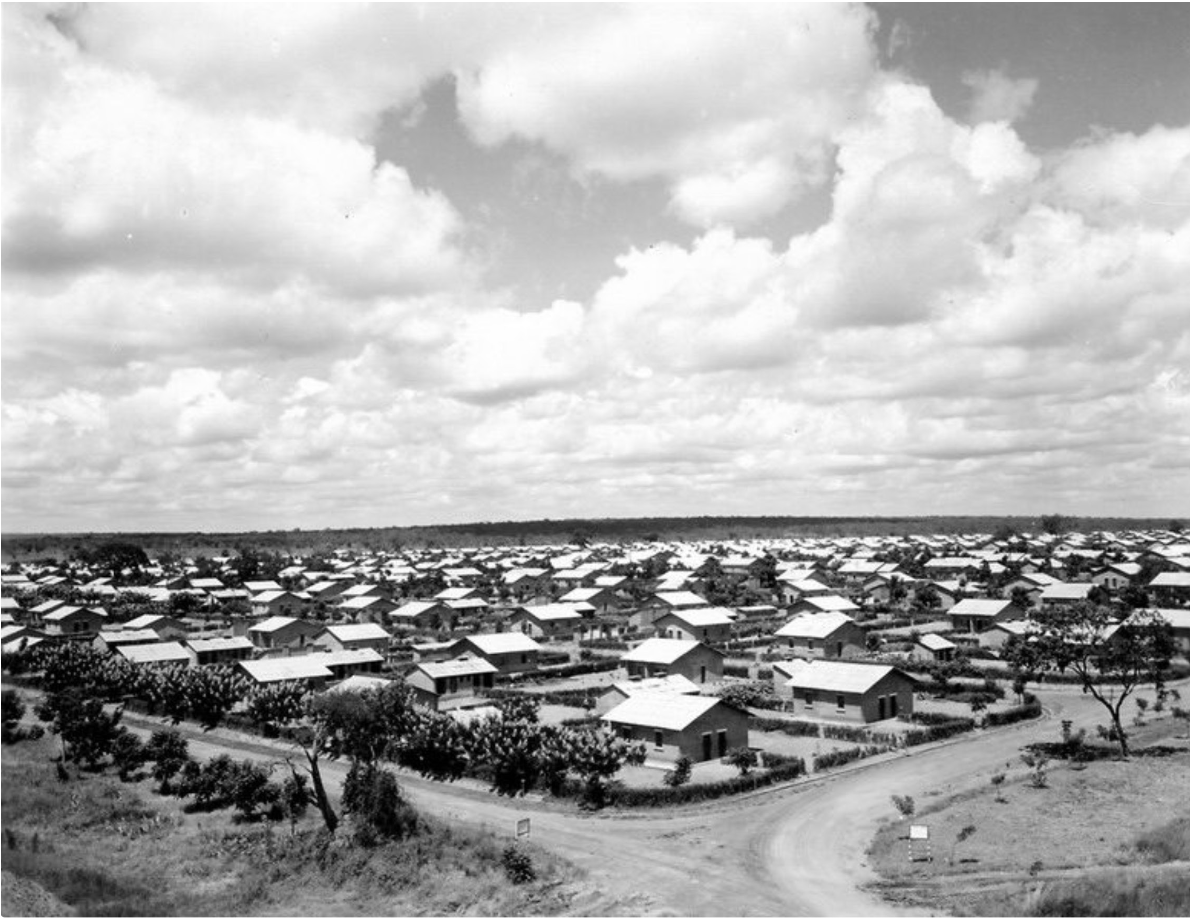
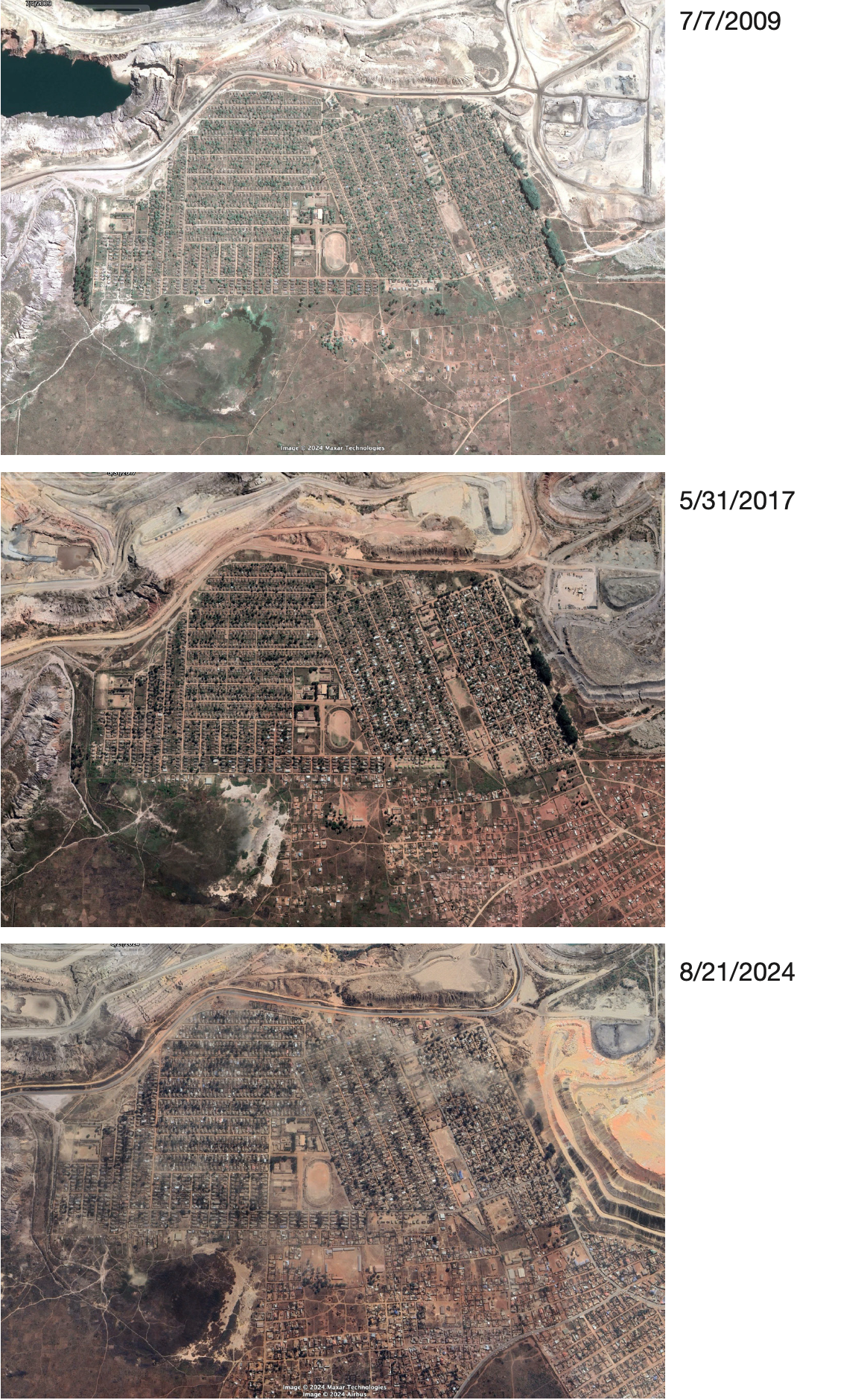
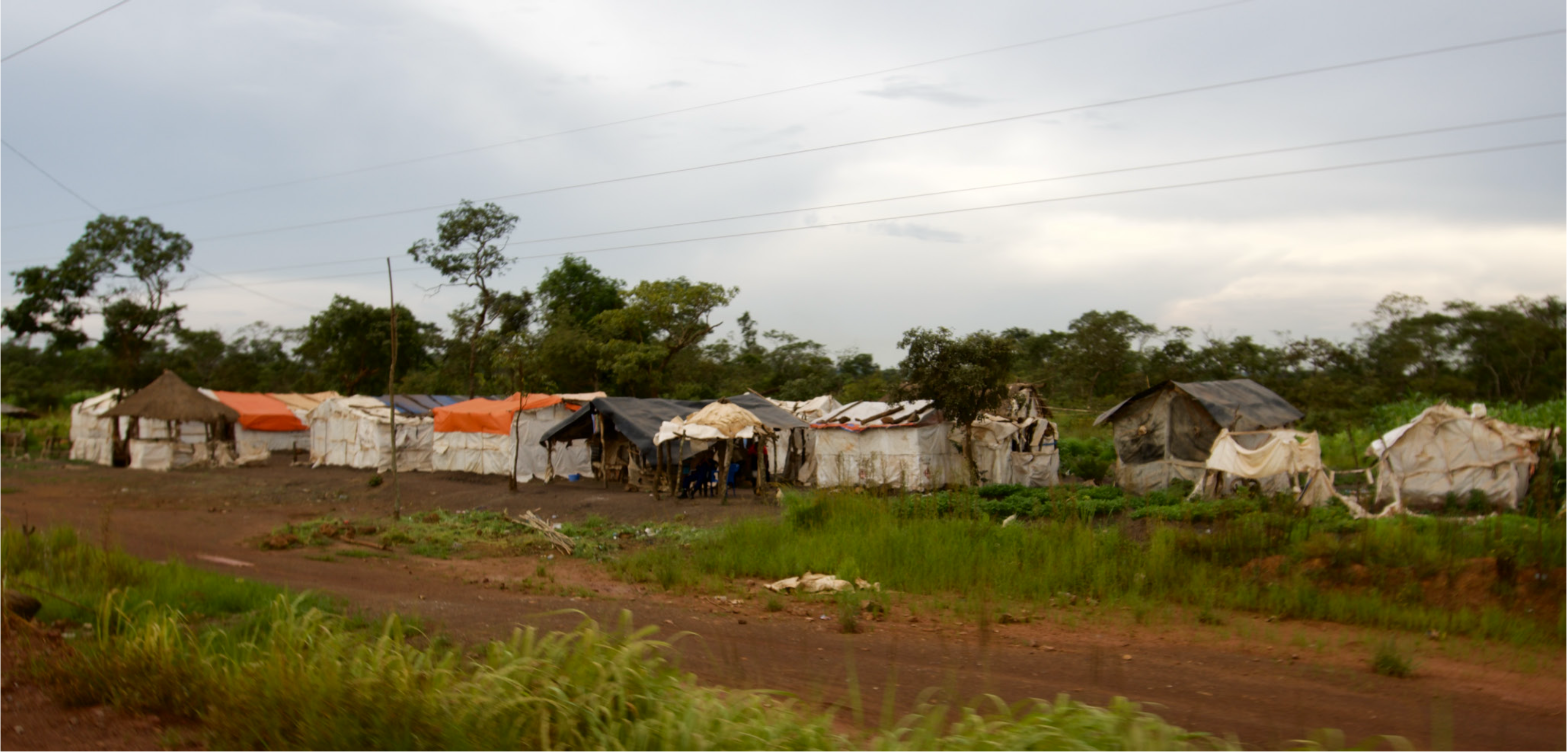
Musonoi, one of the original worker camps of Kolwezi, has survived the booms and busts of the mining industry.
1 / 11
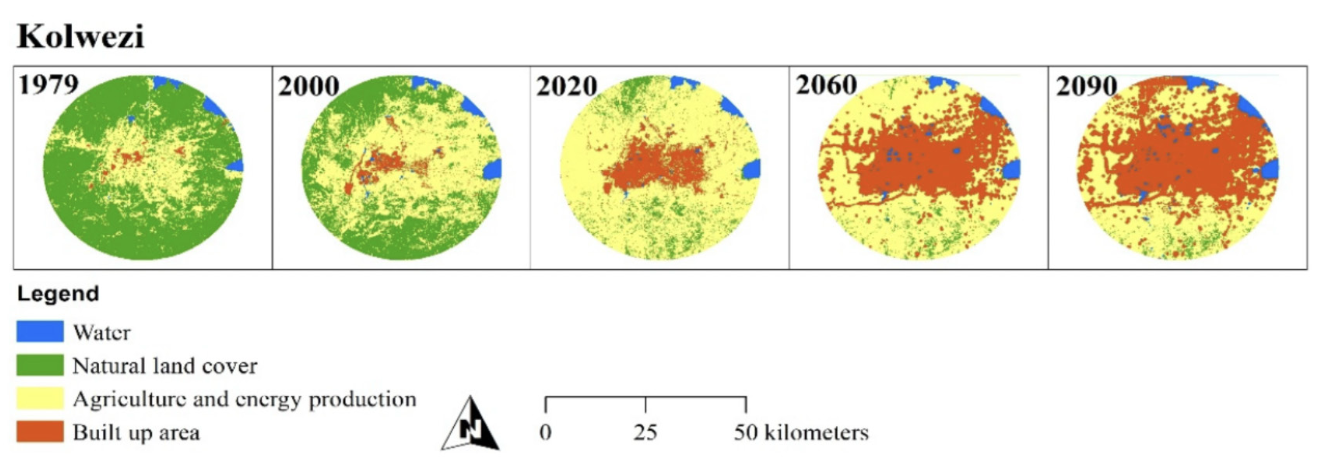
Kolwezi — a large mining city in the Democratic Republic of Congo — is becoming a place of great economic opportunities and precipitous growth. How can the contemporary condition of such a rapidly developing city be explored in parallel with the historic incentives behind its growth? Through charting and comparing historic and contemporary conditions, this essay asks the following question: What spatial legacy is the mining industry creating in Kolwezi?
How to approach such overwhelming urban conditions? Throughout Kolwezi's 88-year history, labour housing has been the defining typology of the city. It is taken as a starting point for understanding the dynamics of the city and its interaction with mining capitalism. Indeed, labour housing was one of the most widespread built elements of the early enterprise (Home 2000). My methodology involved direct fieldwork, ballasted by readings of maps and satellite imagery. Through site drawings and photography, I started to understand labour housing patterns at the sites I visited; through walking and driving I came to understand their relationships with the nodes and spaces of the city. Map analysis was a valuable method for identifying urban typologies within the city. I am indebted to the anthropologist Benjamin Rubbers for his vital genealogy of Katangan worker's camps which formed a starting point to examine the relationships between labour and space in the mining industry. I follow the footsteps left by architectural theorist Bruno De Meulder's navigation of the spatial logics of early camps.
In establishing a series of 'spatial rationales' for early camps, I have used a Foucauldian framework for identifying spatially embedded systems of discipline and control. In analysing the 'micro-scale adaptation[s]' in the old worker camp of Musonoi I have recontextualised De Certeau's concept of tactics (Kamalipour and Dovey 2020:7; De Certeau 1984). Finally, I have drawn on the economic sociologist Karl Polanyi's understanding of labour as a 'fictitious commodity' (Polanyi 2001).
This research uses the old worker-town Musonoi and an analysis of modern camps to assemble scenes of Kolwezi today: a spatial paradox where global corporations touch the ground, whilst the city 'continuously expects its inhabitants to (be prepared to) move' (Kristien Geenen 2021:3).
Kolwezi From Above: Incidental City
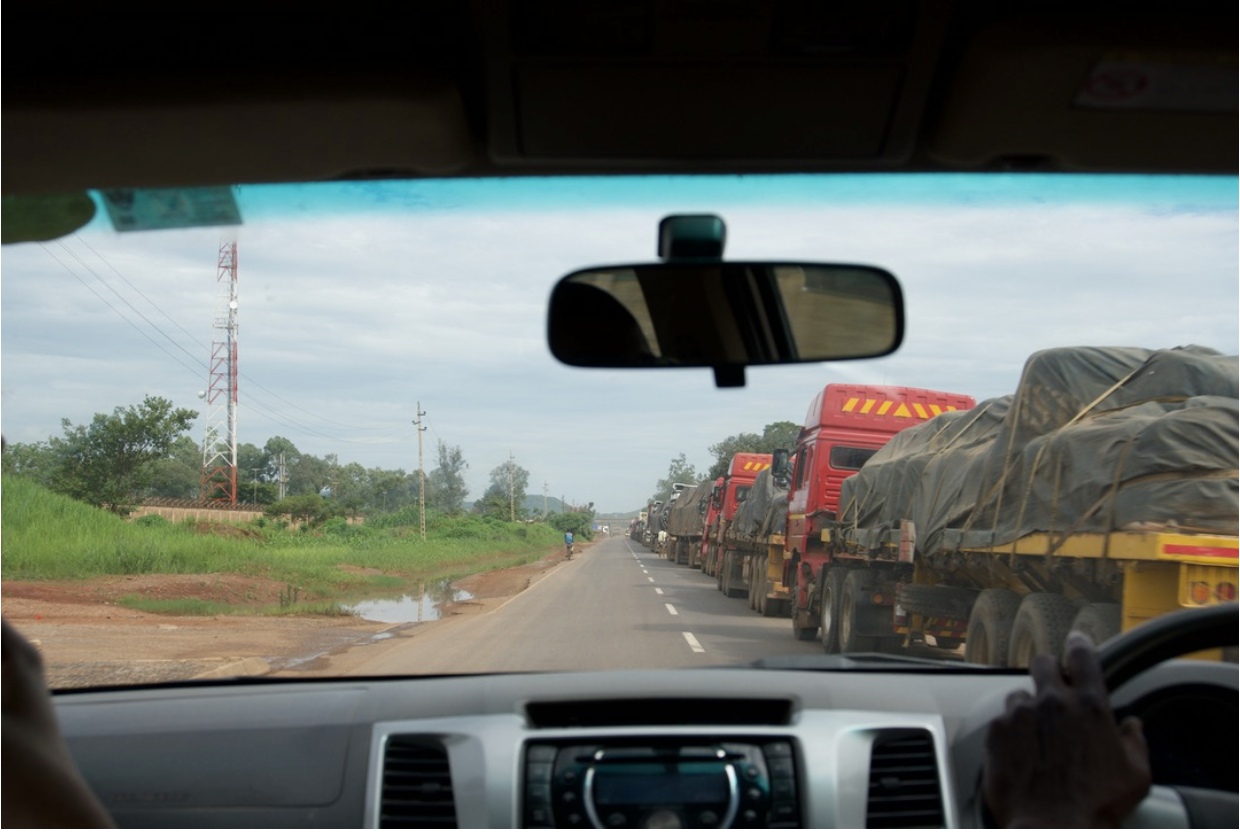
En route to Kolwezi, the road is blocked with trucks. They stretch on for kilometres, disappearing into the horizon. Our driver, Pippo, dressed in a two piece suit, leisurely smokes a cigarette out of the window. A soldier comes by and asks for un café, a bribe. The sun is shining through the windscreen. Pippo is relaxed. This traffic is normal, part of a four hour drive that can take all day.
Each truck on the road has a capacity of 30–40 tons of ore. The current evaluation of copper is roughly US$10,000 per ton; cobalt is roughly US$33,000. By the time you reach Kolwezi, tens of millions of dollars worth of copper and cobalt have driven past you. This is the creation of value on a huge scale, the first step in the supply chain that ends in the sale of electric cars, phones, and other products of the global market economy. Cobalt is a critical mineral in battery production, whose demand is growing, and a key part of the conversations around an ethical green energy transition, as well as geopolitical fears over weak mineral supply chains (Financial Times, 2024). This makes the DRC, the supplier of 70% of the world's cobalt, increasingly relevant as an area of study.
Extractive industries constitute 98% of the exports of the Democratic Republic of the Congo, and the country is largely dependent on its mineral sector. Consequently, cities like Kolwezi are experiencing rapid rates of mineralised urbanisation: 'the influence of mineral production cycles and commodity chains on urban growth and settlement patterns at local, regional and national level' (Bryceson and MacKinnon 2012:514). This precarious dependence on the movements of global markets has spatial consequences, and mining has entangled global systems with local spaces.
Kolwezi is not simply a city built by mining — it is a city continuously in dialogue with the spatial legacies of mining and its contemporary endeavours; from the colonial camp to the postcolonial suburb, from the roadside comptoir to the informal settlement. Kolwezi has been seen by mining companies and the state as a temporary exercise; there is an essential conflict between things that move and things meant to stay. Industry is the final arbitrator: The mines move, so the workers move, the villages move, the city moves, and capital and copper move out of the region. This long-standing precarity and lack of a long term plan inform some of the uneasy questions about Kolwezi's present-day development.
1. Existing Literature
Despite its importance in the global mineral economy, there is a lack of sustained architectural and spatial analysis of mining's effects on Kolwezi. Existing literature is notably interdisciplinary, often combining ethnographic, sociological, and economic analysis with urban development theory.
Two urban studies of Kolwezi produced by the geographers Bruneau and Fu-Kiau have proven vital; similarly, Gregory Mthembu-Salter's overview of Kolwezi's history has provided an invaluable frame of reference for the city's recent development, as has the work of Kristien Geenen (Bruneau and Fu-Kiau 1986, 1989; Mthembu-Salter 2009; Geenen 2024).
A number of broader Copperbelt histories have been useful for understanding the historical context and development of the area and the period of corporate paternalism (Higginson 1989; Henk 1988; Perrings 1979; Young and Turner 1985). Literature on booms and busts in mining towns have also provided a point of introduction for understanding the topic (Büscher 2018; Calvão 2018; Dilsaver 1985; Mthembu-Salter 2009).
The global relevance has led to a resurgence of ethnographic literature on the Copperbelt (Dia de Mwembu 2001; Mususa 2014; Rubbers 2017, 2021). As large-scale mining (LSM) operations have increased in the 21st century, so have artisanal small-scale mining (ASM) activities: mining carried out by individuals, both legally and illegally. These creusers (miners) are best described as individuals of a labour submarket, 'in a subcontracting relationship with industrial mining' (Governing Mining 2020). I have drawn on ASM literature in my research due to its interactions with literature on informal urbanisms (Marais et. al. 2022; Kamalipour 2023; Mukhija 2001).
2. Accidental City
The Union Minière de Haut-Katanga (UMHK) was founded in 1906, an alliance of British and Belgian capital which planned to exploit the newly discovered reserves of copper and other precious metals in the Katanga, the southernmost region of the Congo, and its mineral-rich economic engine. In 1900, the site of the future city was savannah; a sparsely populated area with rich red soil, covered in acacias and dotted with termite hills. By observing local villages' mining practices, Belgian prospectors made the 'discovery' of three large deposits in the area: Musonoie, Ruwe, and Kolwez.
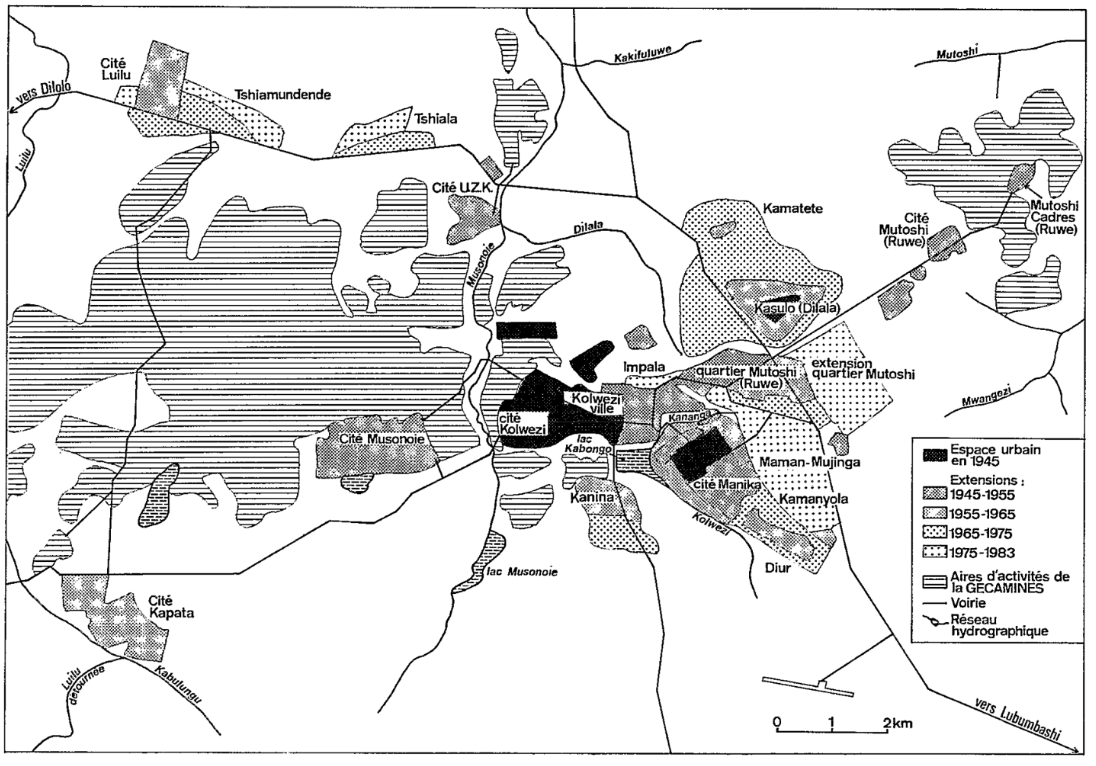
Mining attempts were as early as 1908, but the logistics of transportation made the site impractical. When, in the 1920s, 'it became clear that a railway connection to the future town of Kolwezi would be forthcoming', UMHK resumed work there (Henk, 1988:156). One of the earliest camps was Musonoi, built initially in 1928. A city was founded in 1937 on a 'polynuclear model' (Bruneau and Fu-Kiau 1986:218), composed of a white-owned shopping centre with a periphery of housing for white employees of the company; cités indigenes; and cités l'œuvrieres (worker towns) for the Congolese employees.
The problems of the city today can be traced to this series of urban oversights. The problems were twofold. Firstly, the city's location: in the frenzy to begin mining, Kolwezi had inadvertently been built on top of mineral deposits.1 Secondly, the rapid growth of the city. In 1947, the architectural-urbanist Noël Van Malleghem was hired by the Belgian authorities to survey the city; in his report he emphasised both the impractical graft of the city to the mines, and the lack of a rigorous plan in an uncertain landscape. Malleghem expressed it this way: 'we would like to stress how inconvenient it would be if Kolwezi were allowed to expand at its current location' (cited by Geenen 2020:10).
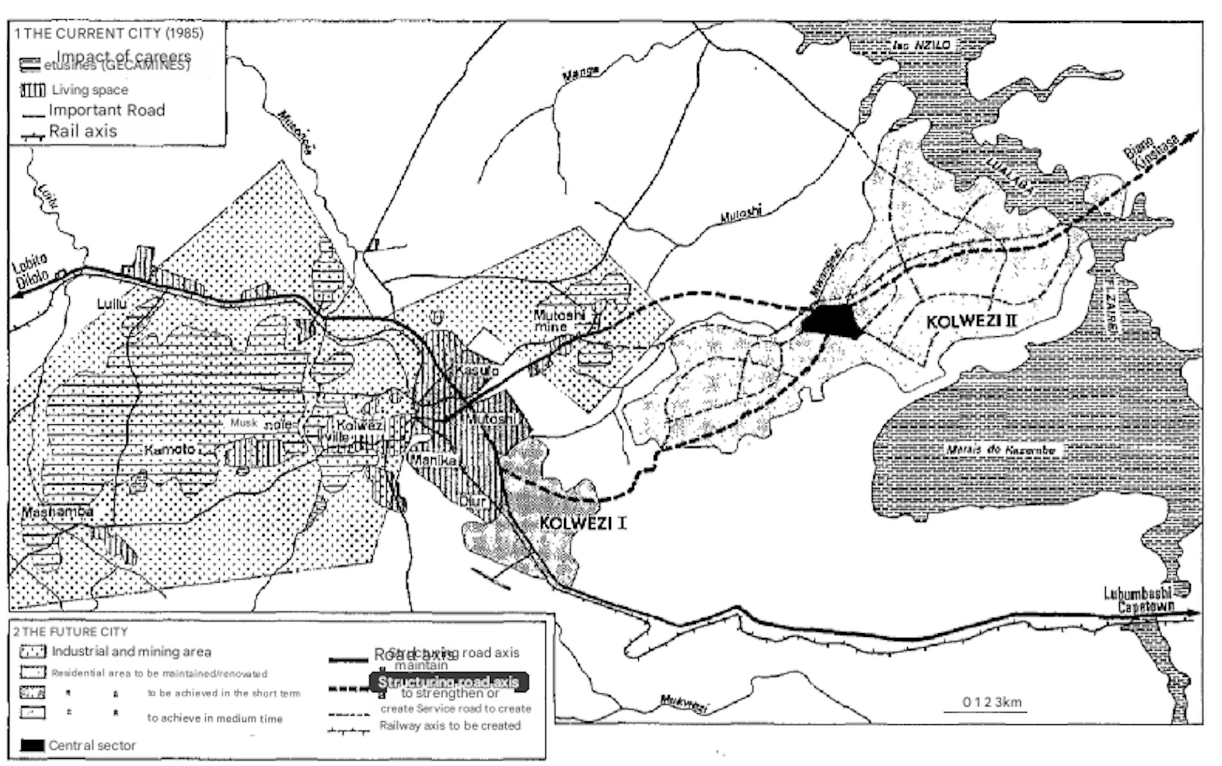
In the 1970s, plans to relocate entire areas of Kolwezi were considered by the Bureau d'Etudes d'Aménagement Urbain in order to liberate the mining areas from the burden of the city. By the time of Bruneau and Fu-Kiau's report, self-constructions were already encroaching on mining areas (Bruneau and Fu-Kiau 1986). The 'Kolwezi II' plan never came to fruition, and the development of a cohesive urban strategy never manifested.
In 1986, three quarters of the city's developed space was occupied by mining sites (Bruneau and Fu-Kiau 1985); today, only 28.7% of Katanga's land remains outside mining claims. As new mineral deposits are found and mining concessions drift South-East, whole areas will have to be evicted and relocated. It is widely known, for example, that Musonoie and Dilala, two of the oldest neighbourhoods in the city and both constructions of the UMHK, are set to be demolished some time in the near future; this is dependent on the mining companies and their ability to secure new concessions in the city.
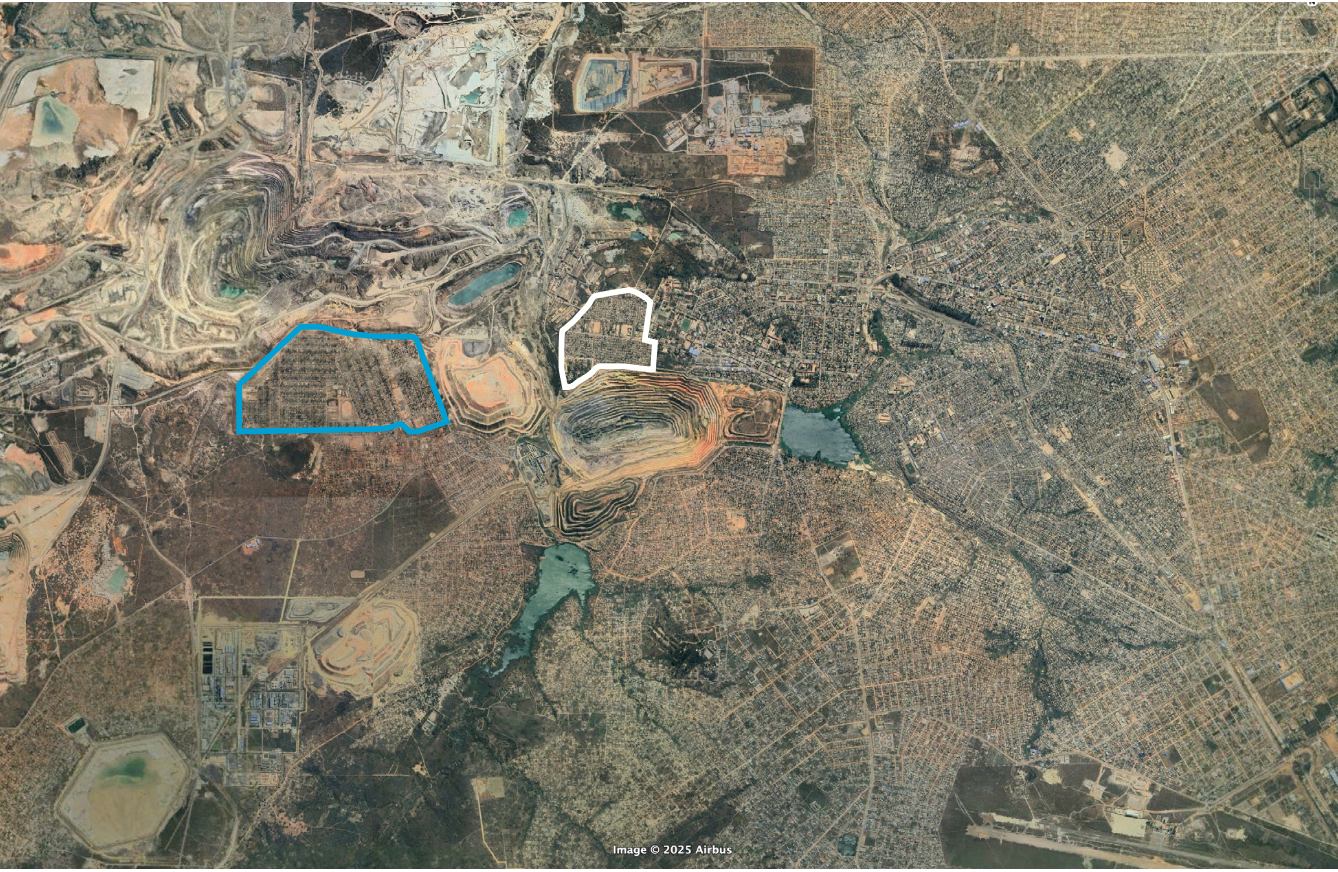
Van Malleghem's concerns were prophetic. In 1958, Kolwezi was the country's 19th biggest city, and by the time of the last nationwide survey in 1984, it ranked 4th (Mthembu-Salter 2009). Since then, and as the city experiences a second urban growth, a dense conurbation has obscured the original cités.
- Already in the 1930s, some of the offices of UMHK had to be destroyed and relocated after it was discovered they had been built 'directly atop valuable mineral deposits' (Geenen 2020:3). ↩
The Camps of Katanga: An Evolution of Spatial Rationales
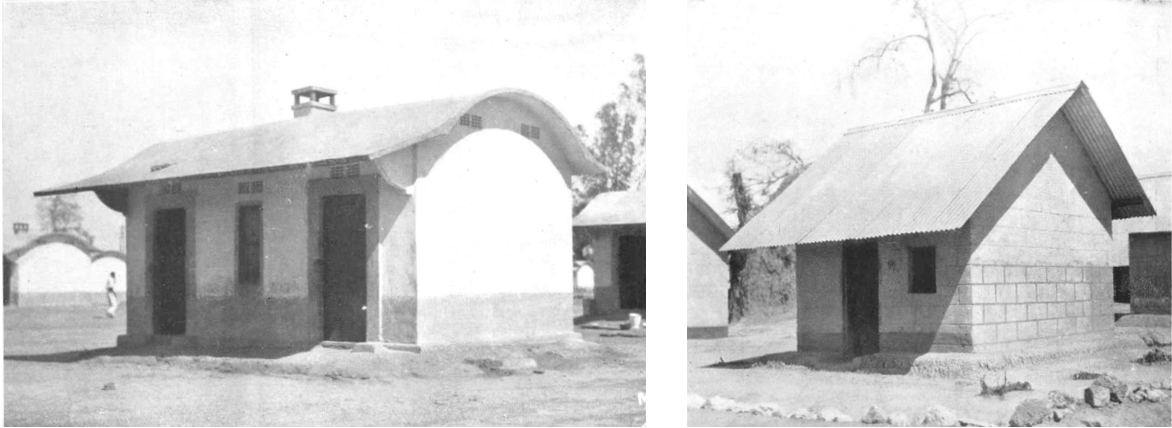
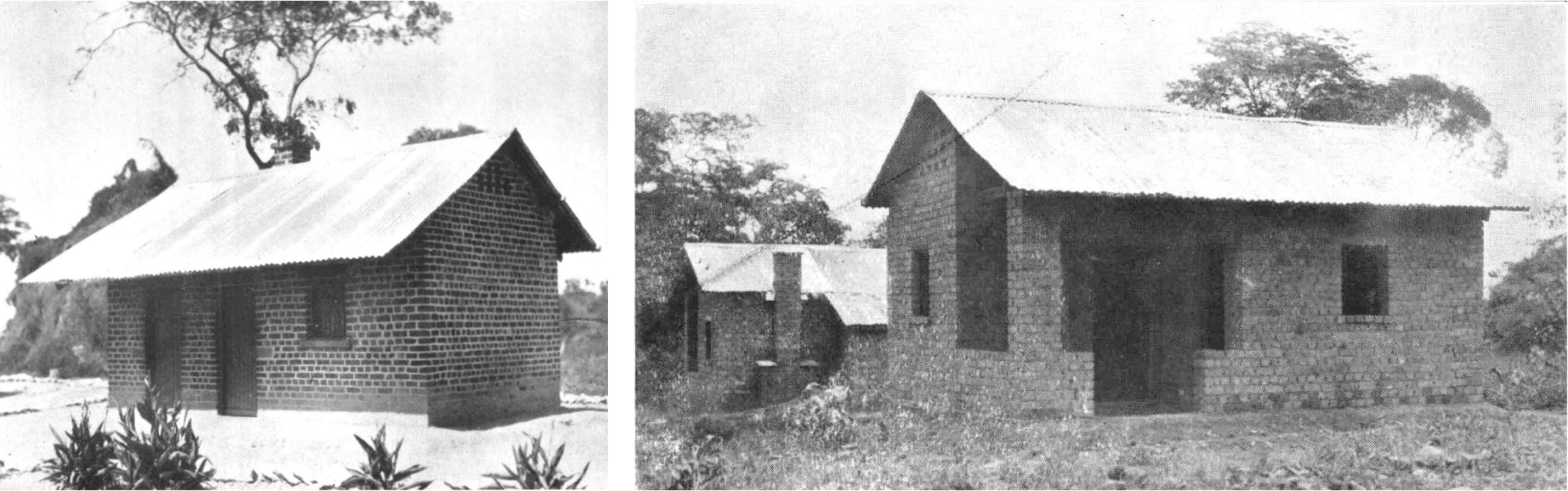
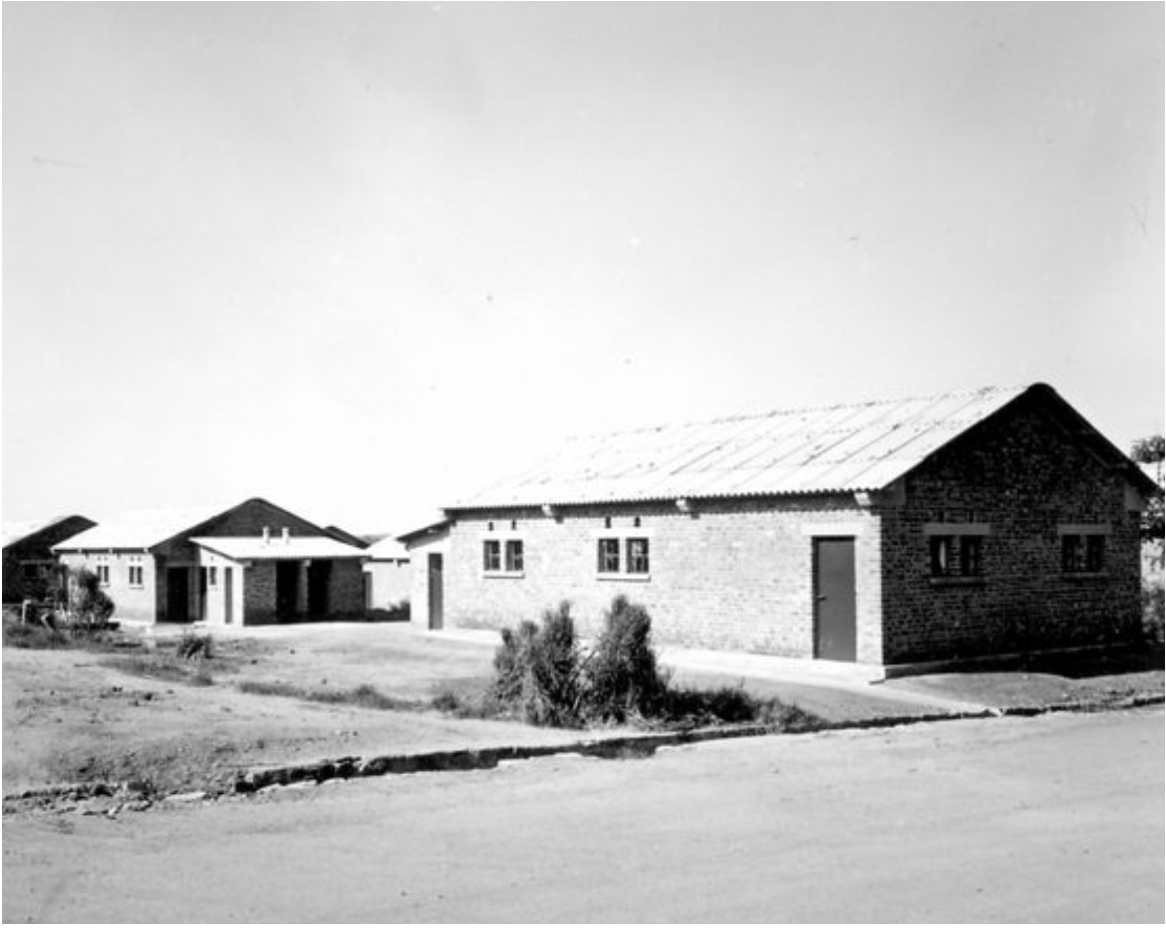
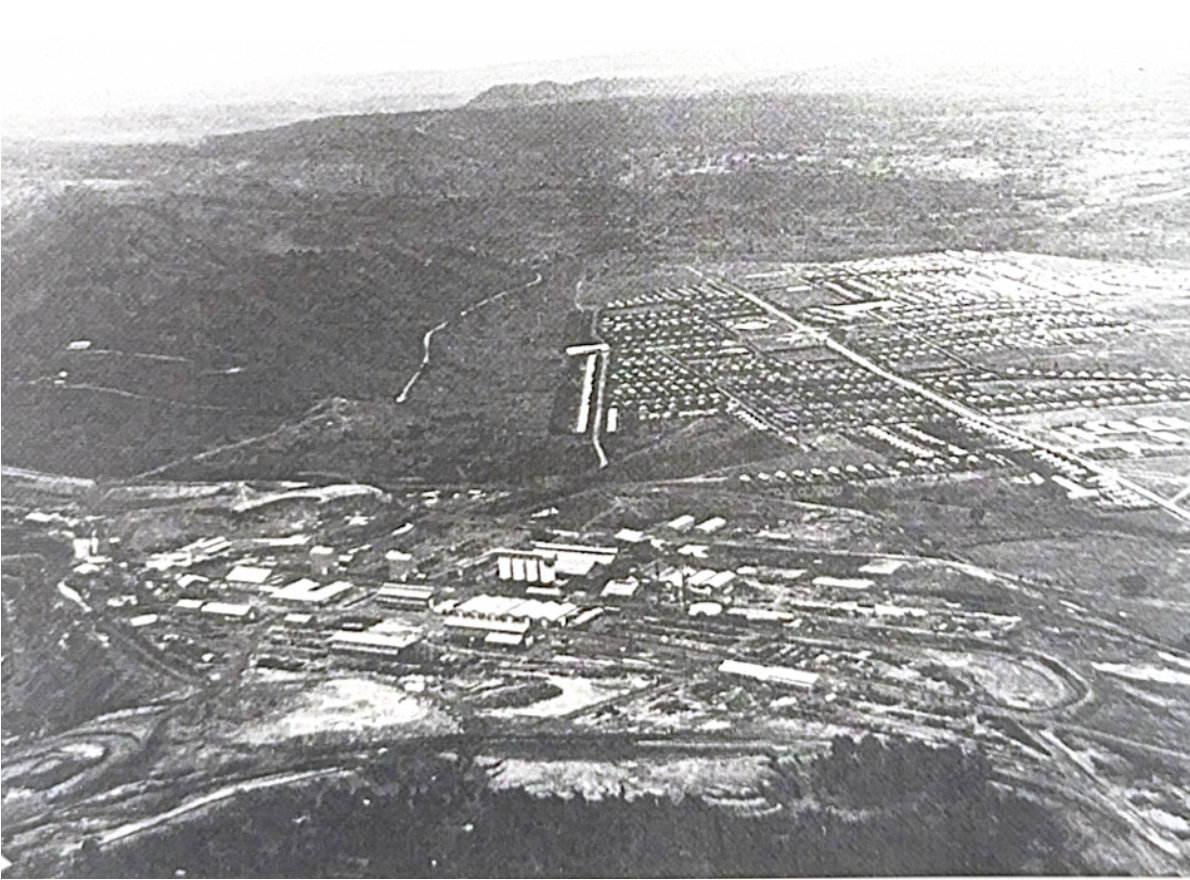
'…slothful and insanitary habits of life…'
(Van Nitsen, 1933:vii)1. Arrival
Camps are precarious spatial entities, 'temporary environments that are created rapidly to respond to a specific situation and are expected to vanish as soon as that reality changes and things return to normal' (Katz 2022:1). The worker's towns that formed the basis of Kolwezi's urban plan evolved from earlier mining camps in the region, part of a genealogy of precarity. Their evolution from early camps is one from spaces of physical control and watchfulness, to spaces which sought to create communities of workers that could be built in the image of the company. The precarity of the early camps found its root in the company's conception of labour as a fictitious commodity, which ignores labour's role as a fact of life connected to the labourer who is producing it (Polanyi 2001). Ultimately, the difficulties of the labour market would incentivise UMHK to develop the 'stabilisation policy' that led to Kolwezi's worker towns (UMHK 1956:163).
The company's early building attempts showed little effort in establishing proper (and long-term) labour housing for miners. Indeed, the general view in 1900 was that 'the negroes will always prefer their miserable huts, made as they wish and where they wish' (De Meulder 1996:18). Companies were initially uninterested in the living conditions of the native, and UMHK had little experience in housing, the general approach being to 'allow our workers the freedom to house themselves as they do now' (De Meulder 1996:18).
Katanga's lack of a local labour supply necessitated mass immigration of natives from other parts of the country, and the construction of labour camps to house them. The native population was seen as a labour reservoir, and railways and roads would allow them to be drained into the worker's camps. As such, the worker's camp was a necessary evil, barely thought out at first, without any 'well-considered labour organisation policy' (De Meulder 1996:17).
The understanding of labour was reflected in the methods of recruitment during the early camps. Disembedded and abstracted into another raw material to be manipulated, workers were subjected to various coercive measures invented to source labour. The head tax imposed by the colonial state put pressure on rural populations to move to urban centres to work. Another early UMHK strategy involved the regular payment of customary chiefs in exchange for security and a steady supply of forced labour, such that labourers were often brought from distant parts of the country to work (Mthembu Salter 2009). Labourers became subjugated to the forces of the market instead of being embedded in social and cultural practices as they had been prior to their employment in the mines.
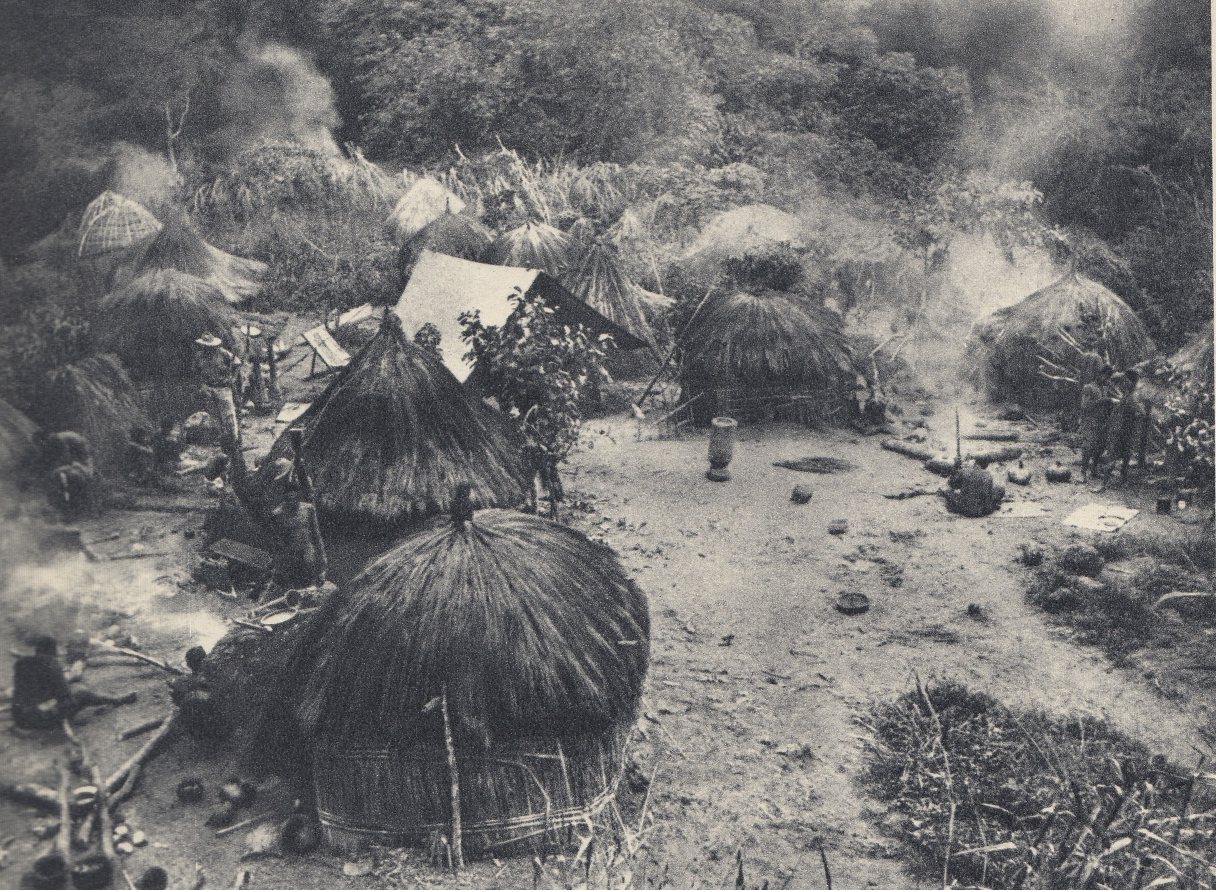
The earliest camps, inspired by contemporary South African systems, were built resembling barracks. The dormitory-like 'Orenstein blocks' had the 'serious disadvantages' of 'contagion, difficulty controlling epidemics, lack of privacy [and] unwillingness of workers to share rooms' (Van Nitsen 1933:40). The terrible conditions of the camps, which involved corporal punishment, low wages, not to mention the dangerous nature of the labour, led to high desertion rates and frighteningly high death tolls. Foreign populations, sensitive to the conditions of their new environment, had further increased both the death toll and the complexity of recruitment.
As a result, the labour camps evolved as UMHK began its attempts to control the conditions of labour. The goal was not to culture or civilise, but to generate and leverage the productive capacities of the population. The spatial rationale of these spaces became one of biopolitical control, with hygiene the key parameter of these early schemes. This actuated investment in a more rigorous scientific ideal of housing.
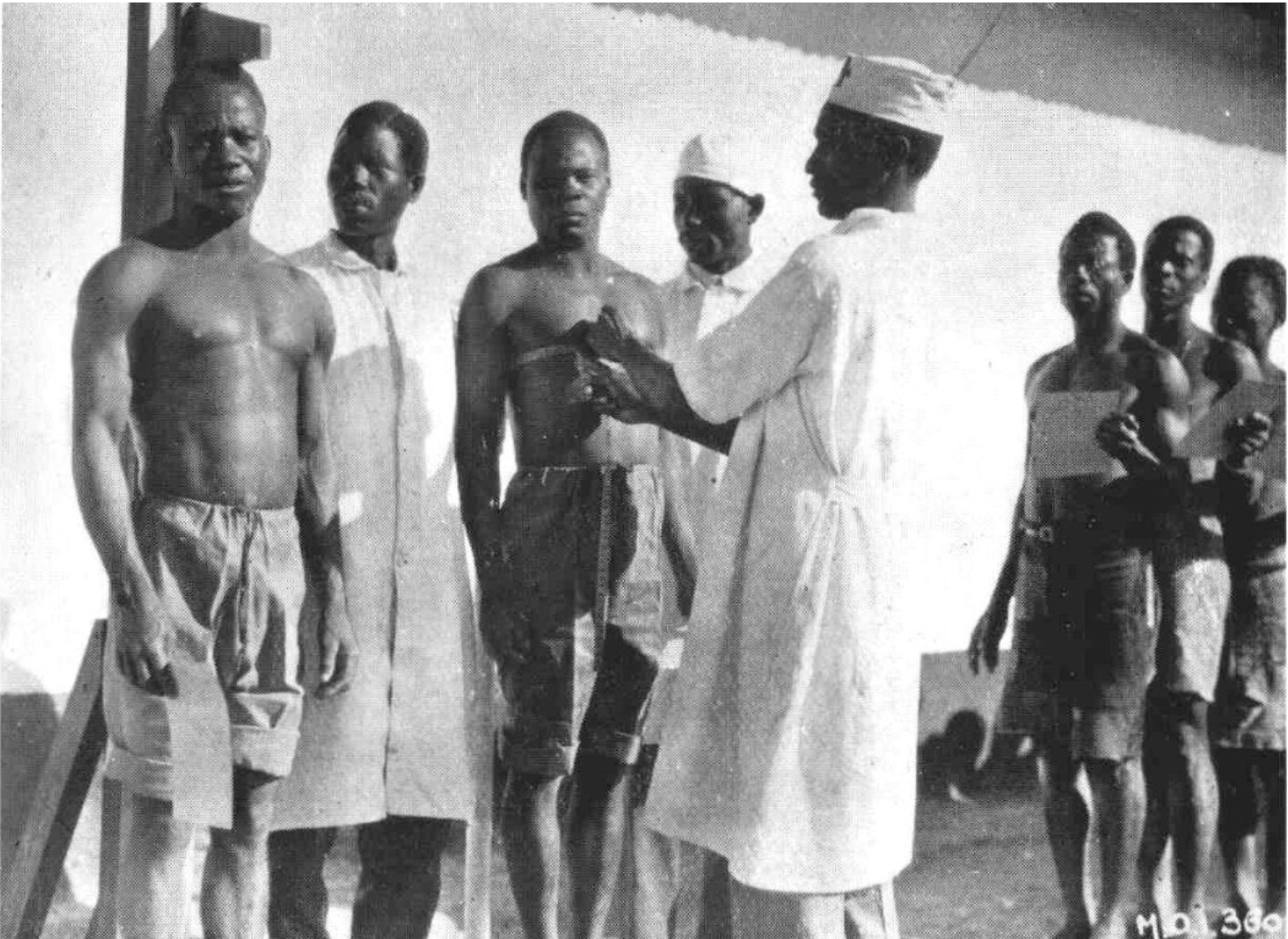
Through interbellum health reports, UMHK's privately commissioned doctors became important sources for informing the spatial rationale of the camp's layout and architecture. In Mouchet and Pearson's medical report, architecture was used as a means of lowering the death count and crucially of preventing the spread of disease (Mouchet and Pearson 1923). Biopolitical experimentations with architecture began as form-finding processes for the camps. The medical framework of empirical data allowed for iterative testing of layouts, which formed an early design principle. The surface area of window apertures, the square meterage per person, the amount of carbon dioxide inside the rooms, and the floor heights above ground level were all metrics used to determine the design of the huts.
These medical discoveries were contemporaneous with the improvement in building materials of the camps, such as earthen floors being typically replaced by those raised by concrete to deter fleas, and wooden plank beds being adopted to avoid fleas. The programmatic designs also changed: vegetation was systematically removed; the camps were oriented along lines of drainage to avoid stagnant water which might lead to the proliferation of water-borne diseases; and the materials of houses began to change and become standardised for cost and hygiene. In the logistics of housing construction, the unskilled native became a computationally reducible apparatus: the speed at which they laid bricks, their skill with cement.
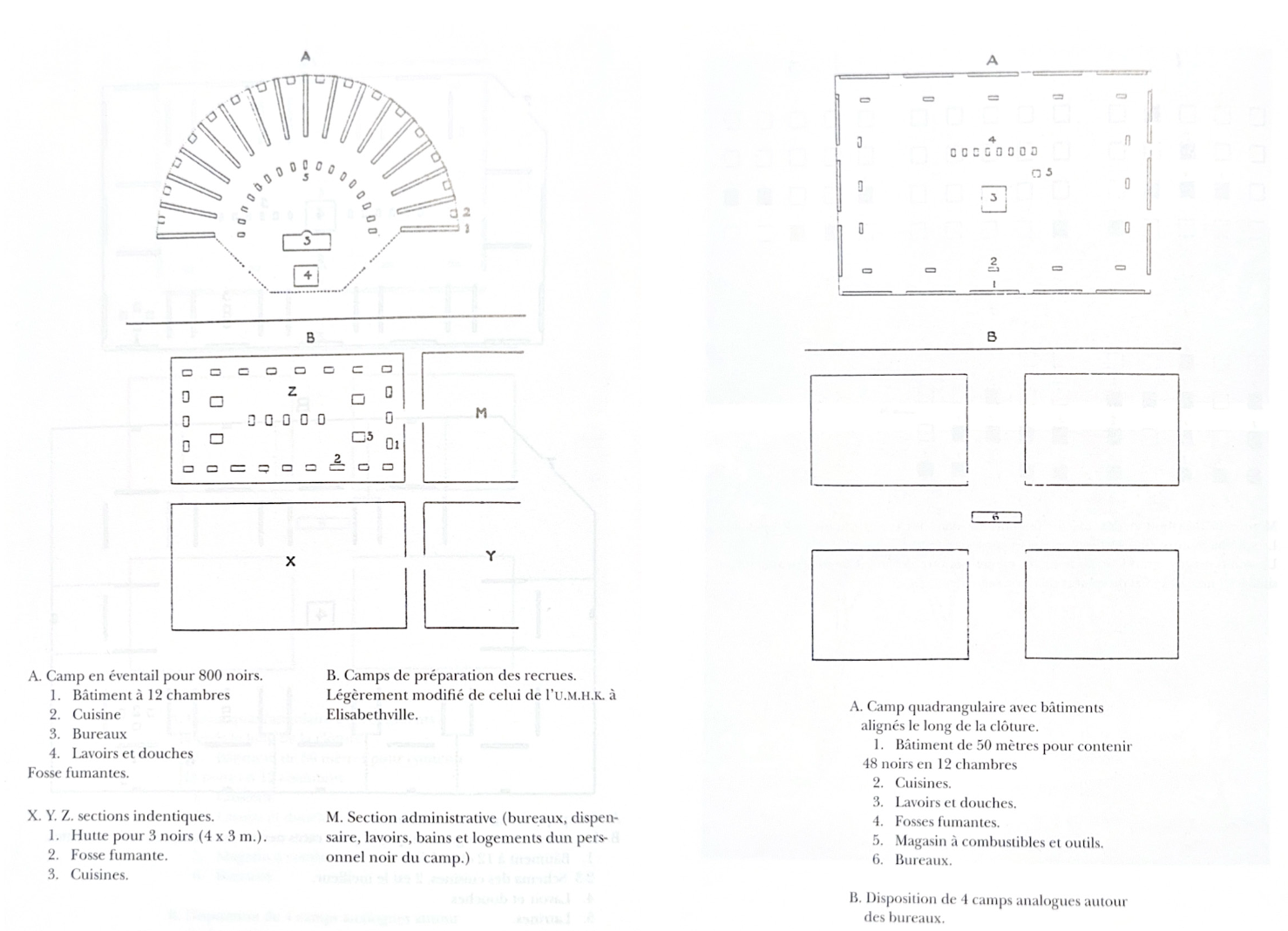
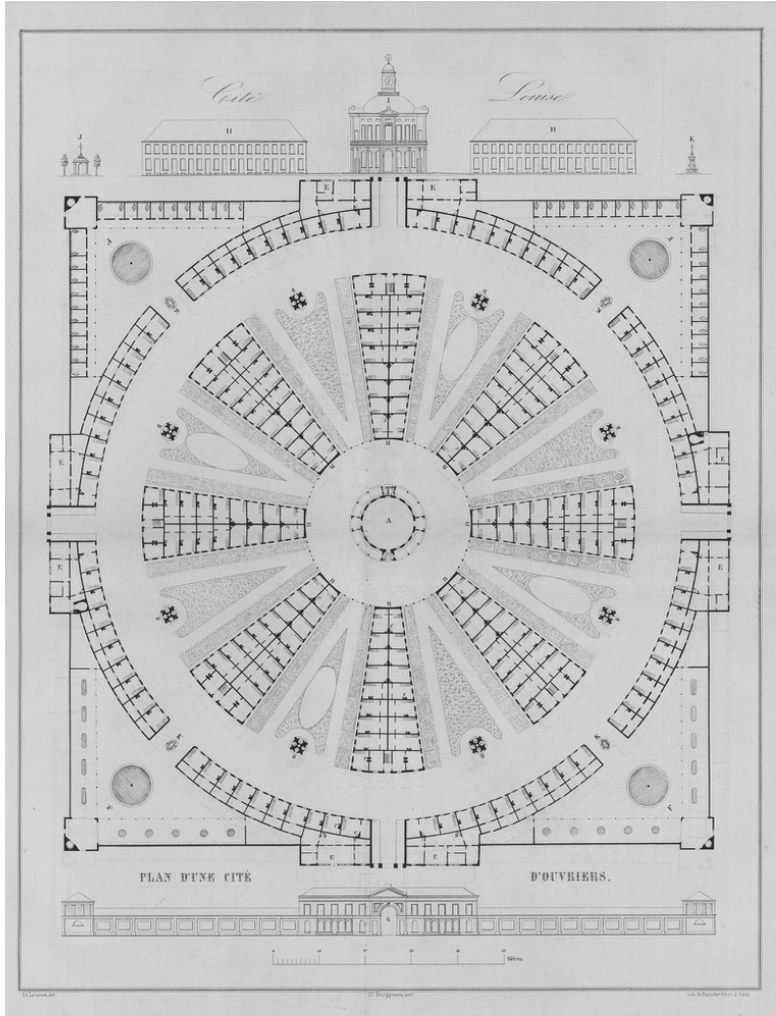
The iterative experiments taken with the plan of these camps evolved from a simple grid of points into something blatantly concerned with surveillance. In one early iteration, the 'panopticon is squeezed into the figure of a rectangle', spatially awkward but with a single longitudinal axis that allows a view of the entire camp (De Meulder 1996:29). Another, radial in layout, is evocative of the Belgian urbanist Burggraeve's Cité Louise, a proposition for an ideal worker settlement (De Meulder 1996). A set of offices sit at the centre of the radius, allowing surveillance of the camp that emphasises direct sight lines; behind this sit shared bathrooms, outside of the camp for hygienic reasons. This process also entailed the specialisation of spaces.
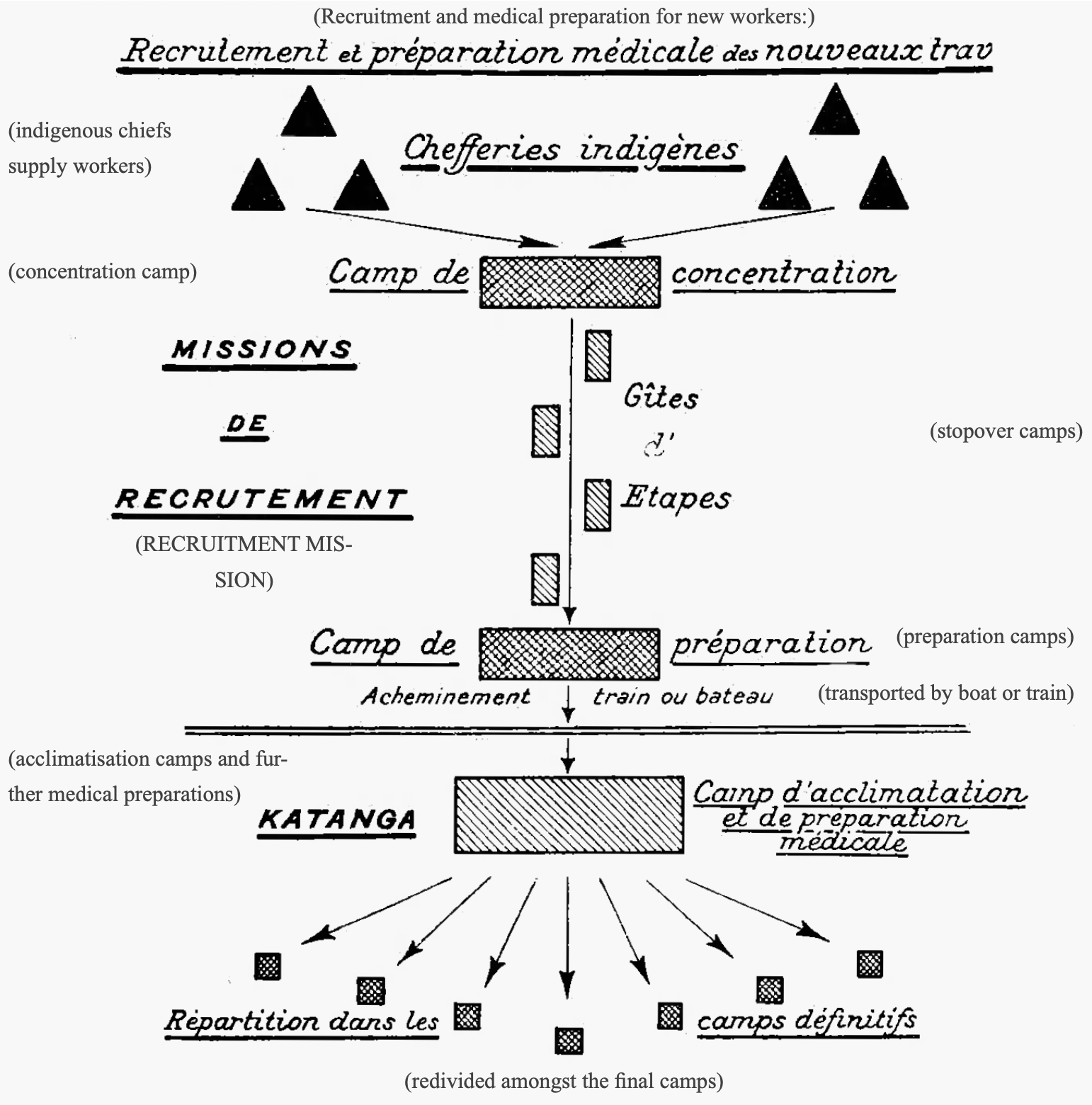
These experiments failed. Persistently high rates of desertion and sickness remained (Dia Mwembu 1990). In addition to this was the organisational complexity of the recruitment process. This logistical organ involved several preparatory stages with dispensaries and infirmaries, 'camps de concentration' and 'camps de préparation', and the added eugenic complexities of identifying which 'indigenous breeds' would create the best worker (Van Nitsen 1933:7–10).
3. Stabilisation
Unregulated labour exploitation, of which the plans of the camps had been both a tool and a reflection, had ultimately caused a market failure. Labour had previously been modelled with no regard for the life of its producer; the crisis of the labour supply inhibited the company from continuing to operate along this model. The company had to in some way 're-embed' labour. This was the birth of the stabilisation policy, which UMHK issued internally in 1927.
The key product of the stabilisation period was the cité l'œuvrieres (worker town), a new spatial system for the organisation of labour structured on the legitimacy of positivism. Through this new policy, the company would swap out the unreliable techniques of coercion for positive incentives, reflecting a rejection of the failed dehumanised ontology of the workers and instead a recognition of their human capital. It was this moralising approach that defined the spatial rationale of the worker town.
The new positive incentives for labourers were economic, social and spatial. Wages were increased, and mining contracts were extended to three years (UMHK 1956). Spatially, the standards of living were rapidly improved through the offering of 'individual houses' which the company doctors, in their identification of a 'psychological factor' of bad housing, had concluded were 'the most sought-after accommodations' (Van Nitsen 1933:33). This change, from 'barrack compounds' to individual houses (Home 2000), marked a transition from spaces that treated the body 'wholesale', to those that treated it 'retail', a system focused on 'supervising the processes of the activity rather than its result' (Foucault 1975:137). Through this change in view, these initially temporary labour housing settlements developed into proto-urban spaces.
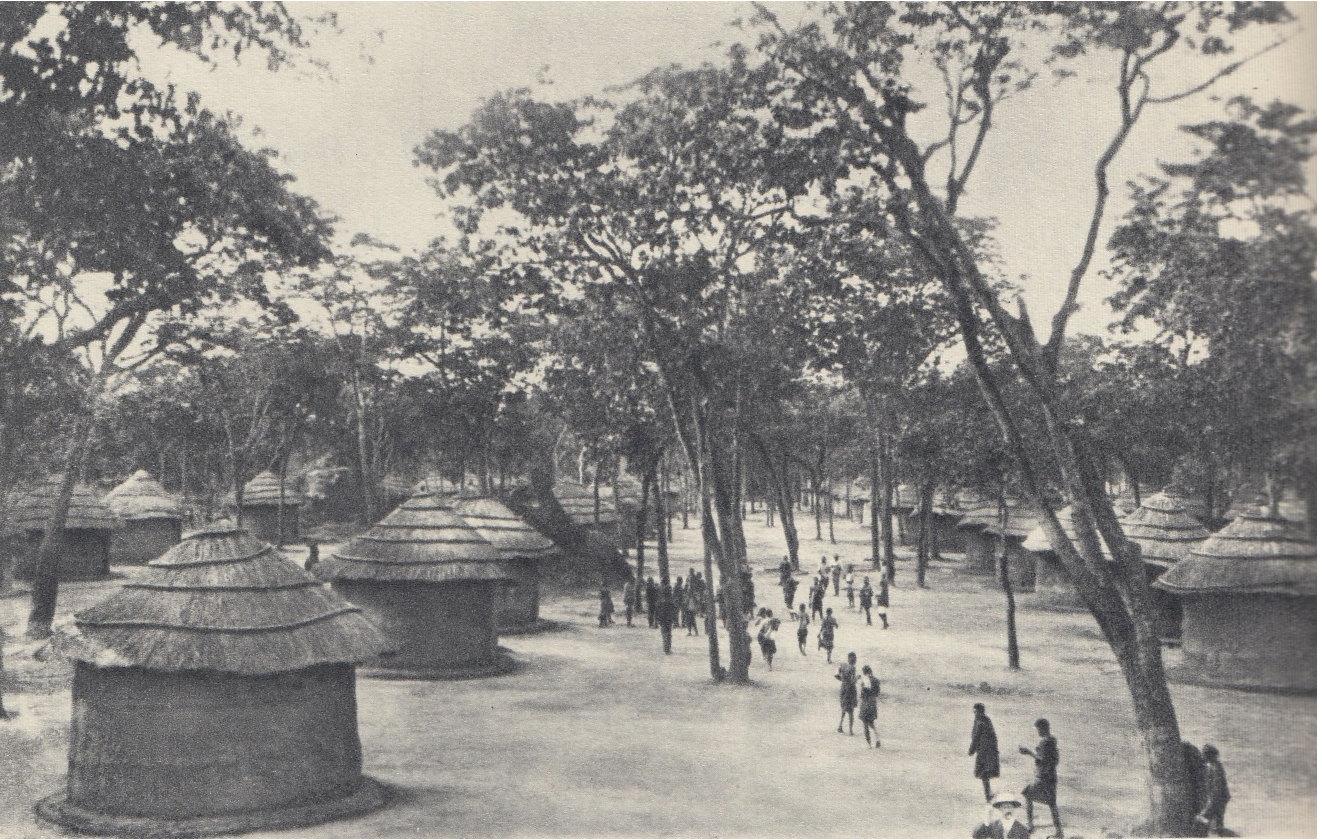
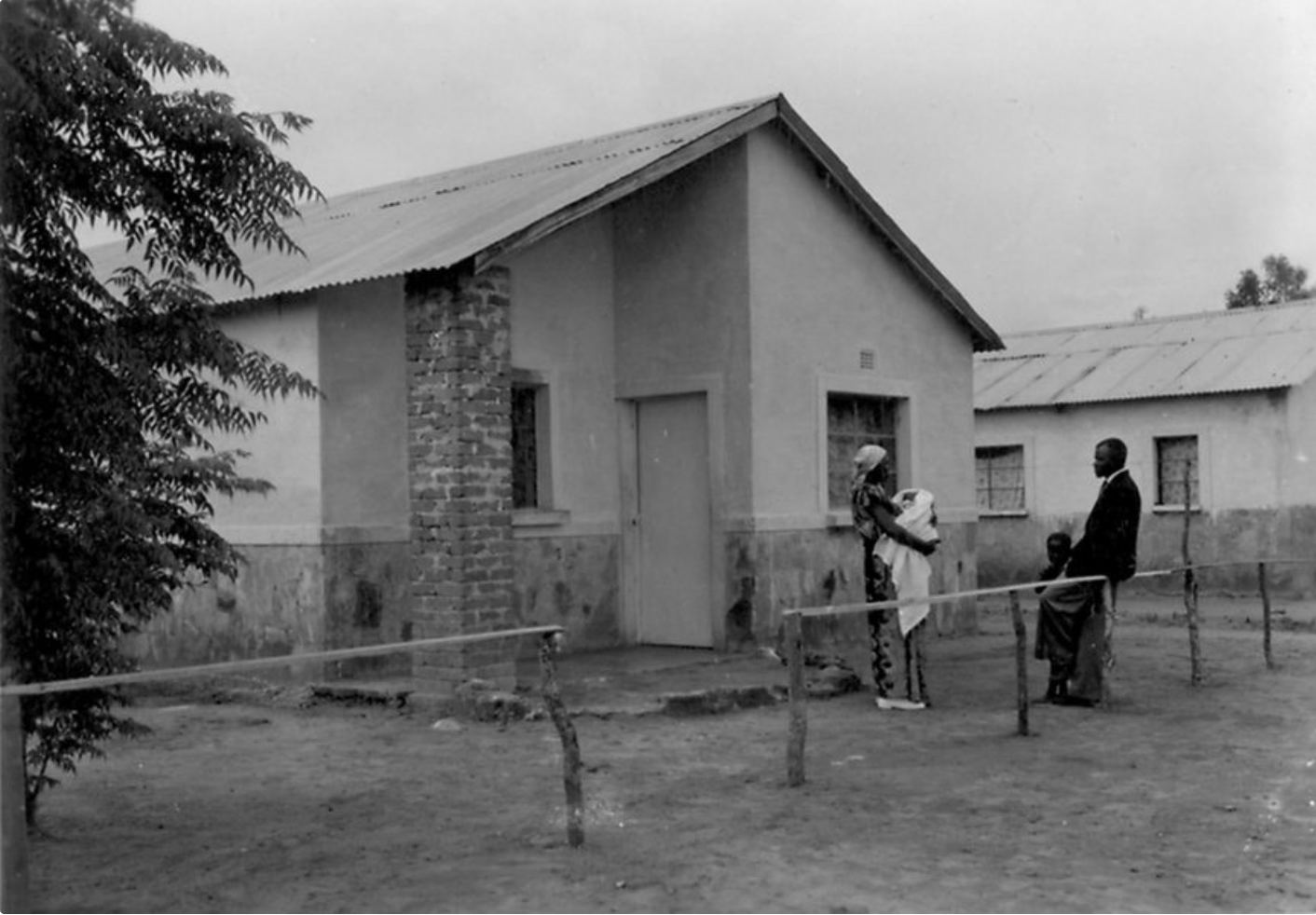
Whilst the early camps had been constructed as temporary infrastructures, stabilisation brought changes to labour housing construction, now built in durable materials such as brick. This was a slow change: 'In 1936, 76.3% of the housing was non-durable. But by 1960, all the housing in UMHK camps was made from durable materials' (Mwembu 1990:86). The non-durable camp at Musonoi was rebuilt in permanent materials in the 1940s (Henk 1988). Kolwezi's abundance of clay soil allowed the new houses at camps like Musonoi to be made of red brick. Through the construction of new 'Maisons type standard' (Van Nitsen 1933:40), the company offered new spatial provisions for the labourer who 'liked to feel it was his house and that he preferred an individual kitchen to a communal one' (Van Nitsen 1933:41). The maison type standard comprised a bedroom of 3 by 3.25m by 2.35m, with a window and door; a kitchen of 1.5 by 5m, a veranda and a bathroom.
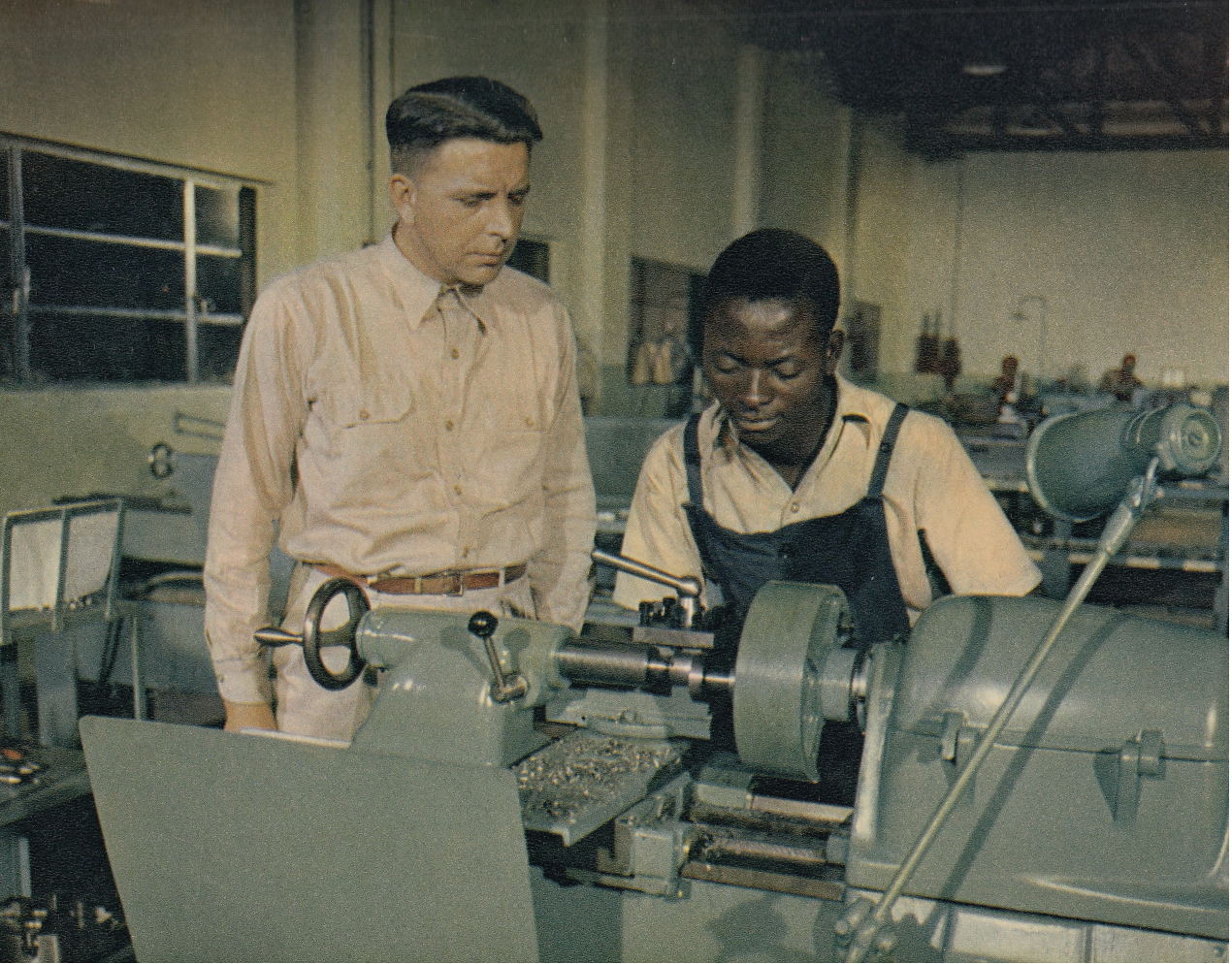
Under the stabilisation policy, a new concept of the labourer as a trainable entity emerged, onto which the values of hard work and stable family life could be imparted; values that would, it was hoped, improve the worker's capabilities as a labourer. This holistic approach encompassed all elements of the worker's life. It was not just the housing they provided, but a totalising system, through which 'the man of the bush takes the first steps towards regular, organised labour, the generator of social progress' (UMHK 1956:165).
The recruitment of women became an important aspect of the stabilisation project, as married workers tended to stay longer and stabilise quicker than bachelors. Workers were invited to bring their wives and children to live with them in the camps, which had previously been disallowed. Family houses for married workers were introduced; these typically had two bedrooms, a bathroom, a kitchen, a shed and a small garden plot. In fact, the company went as far as providing dowries for its bachelors to marry, and 'arranging the transfer of the wife' (De Meulder 1996:83); offspring would become the next generation of labourers. The company had found a reproducing labour supply.
Sensing that looking at the worker as an 'anonymous assistant' would result in alienation, the company increased its efforts at 'concretising' its bond with its employees (De Meulder 1996:84). All information on the employee began to be recorded, from family situation to work ethic. Like at Foucault's Mettray, through the 'disciplinary technique' of amassing data, the labourer became 'a soul to be known and a subjection to be maintained' (Foucault 1975:295).
Simultaneously, social infrastructure like schools, community centres and canteens were built for the use of the workers. Everything offered to workers was part of a social contract signifying something deeper than the simple remuneration of labour. Indeed, money lost relative importance; 'the African salary was considered "pocket money" since the company not only fed its workforce, but also dressed, housed, cared for his family and educated his children' (Dibwe dia Mwembu 2025). In essence, 'human society had become an accessory of the economic system' (Polanyi 2001:79).
Whilst early layouts, with their clumsy expressions of the spatial rationales of surveillance, had treated the labourer as a commodity, the worker town was sophisticated, an arcanum imperii in which the mechanisms of control disappeared into the construction of an artificial moral economy (Thompson 1993).
Despite this embeddedness, worker towns were still seen as temporary fixations, and urbanisation to be avoided. In fact, UMHK consistently encouraged its workers to maintain contact with their rural communities and retire to their villages (Rubbers 2021). The cités l'œuvrieres were artificial communities, places to situate the worker during the period of their employment. Despite this, urbanisation was inextricable from mining; by 1950, Kolwezi's camps brought together around 6,000 people, around a third of the indigenous population of Katanga (Bruneau and Fu-Kiau 1986).
4. Boundary
Somewhere between his garden and his community centre, the native would be transformed through his housing into an upstanding employee; 'immorality [would] recede before the influence of the family environment' (UMHK 1956:165). Spatially, this was shown in the spatial transition from a point on a grid, to a cell — a contained and individualisable space. By the time of Musonoi's construction, the worker town had come to be seen as the theatre where this change would be staged. This process of control gave importance to the boundary.
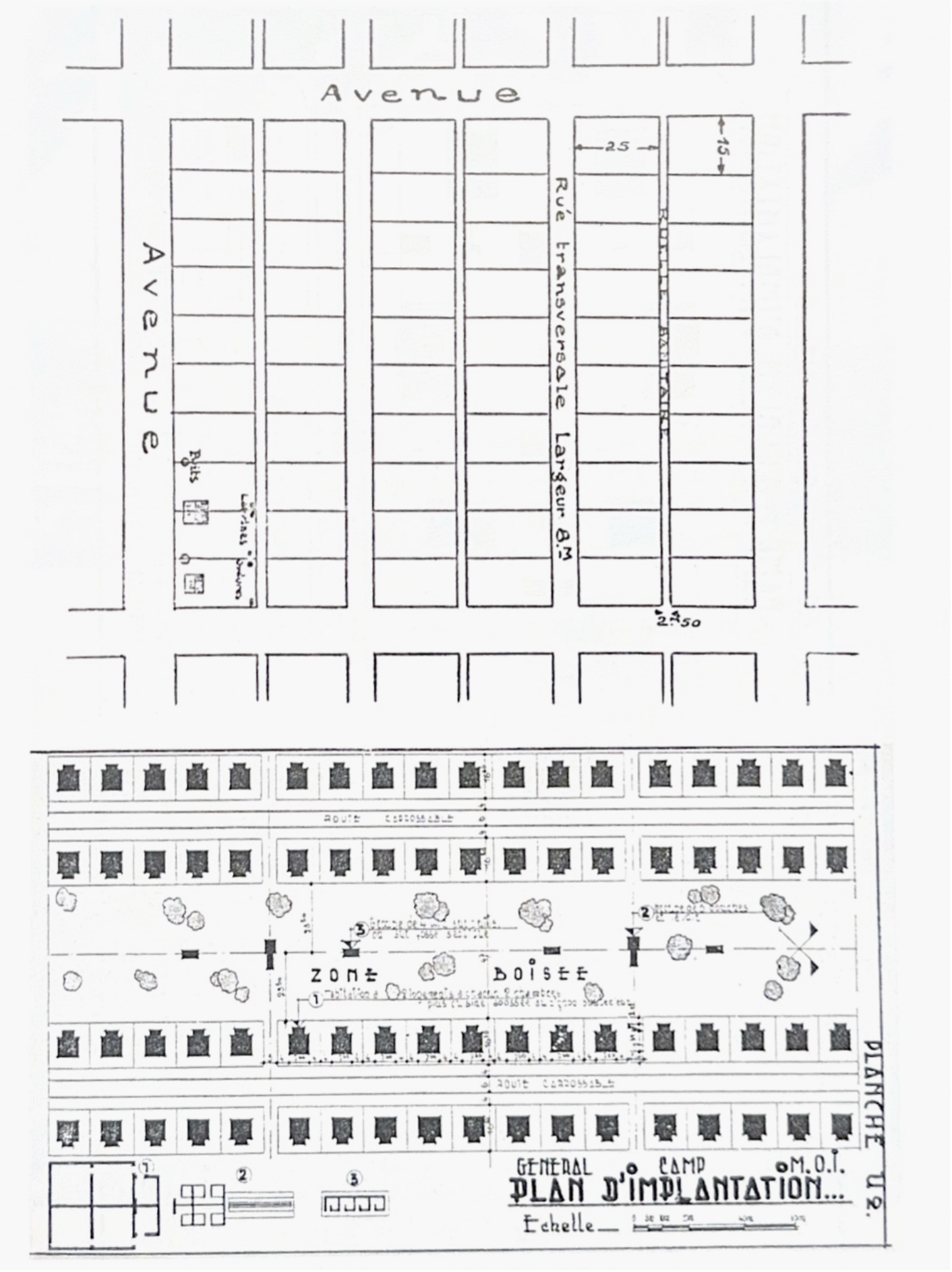
Internally cleansed and outwardly aspirational, the terra firma of the worker town existed in the untamed terra nullius of 'the bush' (UMHK 1956:165). One medical officer writing in 1928 on indigenous labour saw the camps as 'small islands of healthy terrain (îlots de terre saine) in the middle of a deeply infected region' (cited in Walker 2016). Musonoi's plan, composed on a grid, implies an aspirational growth through its modularity, equally appearing as a 'small island' separated from its surroundings.
The grid was also functional: services could be slotted into the grid, allowing for rapid construction; the hospital might take two blocks, the stadium six. Further, the grid would make managing numbers of employees and the planning of camps uncomplicated. As is pointed out by the urban theorists Lombaerde and Heuvel, the 'interpretive associations with domination and democracy' makes posing singular readings of the grid difficult (Lombaerde and Heuvel 2011:ix). In the context of stabilisation, however, it was precisely through this ambiguity that UMHK was able to reap all the benefits of appearing democratising whilst being dominating.
The spatial isolation of these camps had had the side-effect of social dislocation and conflicts with local ethnic groups, which the company did nothing to arbitrate.2 For example, a local chief had complained to the mining company that its Kolwezien employees were using dynamite charges to fish in the lake. When a local chief requested remuneration for the damages, since the lake's supply of fish was depleted, the mining company replied that 'poaching was a matter for the territorial police', and refused to pay (Higginson 1989:139).
The country's independence in 1960 led to the seizure of UMHK. This eventually became the state-owned company Gécamines, who preserved the company's management structures. Under Gécamines, corporate paternalism developed further; worker towns were modernised and provided new services like electricity, whilst workers continued to receive a range of benefits, such as access to company schools, hospitals and sports facilities.
By the 1980s, a significant portion of the mining workforce consisted of individuals whose families had long been associated with the industry, which had successfully re-embedded them into a new social corporate order and moral economy; 'Gécamines is my father, is my mother' had become a common phrase to hear from employees of the company (Vwakyanakazi 1988:86). This would inevitably clash with the message of another Congolese idiom: 'Article 15', the fictional 15th article of the constitution, which says that since the state cannot be relied on, you must debrouillez-vous — 'figure it out yourself', 'do what you must'.
- This would metastasize into ethnic violence in the 1990s. ↩
Gécamines Is My Father, My Mother: State Failure and Spatial Tactics
'When I'm here at home, I don't care about my neighbours. They are in their home, and I'm in mine.'
ex-employee of Gécamines, cited in Benjamin Rubbers, 2017:931. State Failure
Fluctuating global markets, war, and the corruption of the state slowly eroded the mining industry until its complete failure in the 2000s. In the late 1980s, 'Gécamines generated an external revenue of US$1 billion a year' (Tambwe 2011:391). By 2003, Gécamines had 'accumulated roughly US$1.6 billion in debt, was bankrupt, and had not been able to pay a majority of employees in over two years.' (World Bank 2007:10). Four years later, the firm had largely collapsed. Systemic corruption, diversion of funds, and pressure to increase output created a dire cycle for the company in which dropping production rate led to budget cuts, which lowered production. Copper production slowed to almost nothing (Marysse and Geenen 2016). The decline of the cités l'œuvrieres was concomitant with the rapid contraction of the DRC's economy.
Corporate paternalism was seen to have run the risk of producing a 'detribalized' population of mining workers who were dependent on the company for wages and were unable to return to their villages (Rubbers 2018:91). As the process of privatisation went on, 'social service provision largely collapsed' (Larmer and Taylor 2021:343). Gécamines's social welfare had produced a 'protective covering of cultural institutions' without which the workers were prone to the 'effects of social exposure' (Polanyi 2001:76). The economic bust had revealed the underlying precarity of the urban plan.
2. Informalisation
The consequent effect on labour housing was to return it to a state of disorder. In many cases, Gécamines had started to sell its housing back to the workers in the 1980s. This meant that areas once exclusive to company employees were open to be sold or rented to those with no relation to the company. Expectedly, the boundary that marked the edge of the worker towns dissolved; 'a clear indication of this integration of former camps in Congolese "cityness" has been the appearance of bars, private schools, or Pentecostal churches within their boundaries — that is, places formerly associated with the cité, the town' (Rubbers 2019:93).
By the 1990s, the household revenues of Gecamines' workers depended 'to a large extent on parallel activities' such as land cultivation or 'petty trade' (Rubbers 2017:193). The large majority of the workforce was laid off, their incomes already largely cobbled together from secondary sources. Artisanal mining in Kolwezi can be seen as such a secondary source, and began as a survival mechanism in the 1990s, typically carried out by 'either agents of Gécamines or of Sodomiza or other contemporary mining companies' (Itumbo and Ngwej 2015:767).
3. Neoliberalisation
The Congo Wars (1996–2002) led to a mass exodus of mining capital, and the 2002 Mining Code was drafted to encourage foreign investment in the mining sector. Today, this has succeeded in attracting foreign investors interested in exploiting the resources of the country. The cobalt rush has necessitated a mass influx of manpower and capital, leading to a new wave of development, the latest boom in the cycle of 'booms and busts' that are often used to describe the development cycles of the mining town (Buscher 2018). In 2011, mining output reached 500,000 tonnes, greater than Gécamines previous record in the 1970s, and it has now surpassed 3 million (Marysse 2013). Today, many creusers are descended from Gécamines employees. Artisanal miners often develop informal residencies on the fringes of mines or on old concessions, which has led to violent clashes with both private and public forces (International Crisis Group 2020).
Whilst state failure has resulted in the 'emergence of a parallel economy' of living, it has also resulted in one of building (Tambwe 2011:392). Precarity has engendered a precarious approach to space and architecture in informal settlements. This new boom in development resembles the old growth in that it is contingent on the presence of the mining industry, yet differs in that it is carried out by atomised individuals, no longer governed by the spatial schemata of a single company.
Since the 2000s, thousands of creusers have entered into old quarries and their adjoining neighbourhoods like Musonoi, and ASM activities are highly visible around and throughout the neighbourhood. In this way, artisanal mining is connected with labour housing and Musonoi.
4. Musonoi
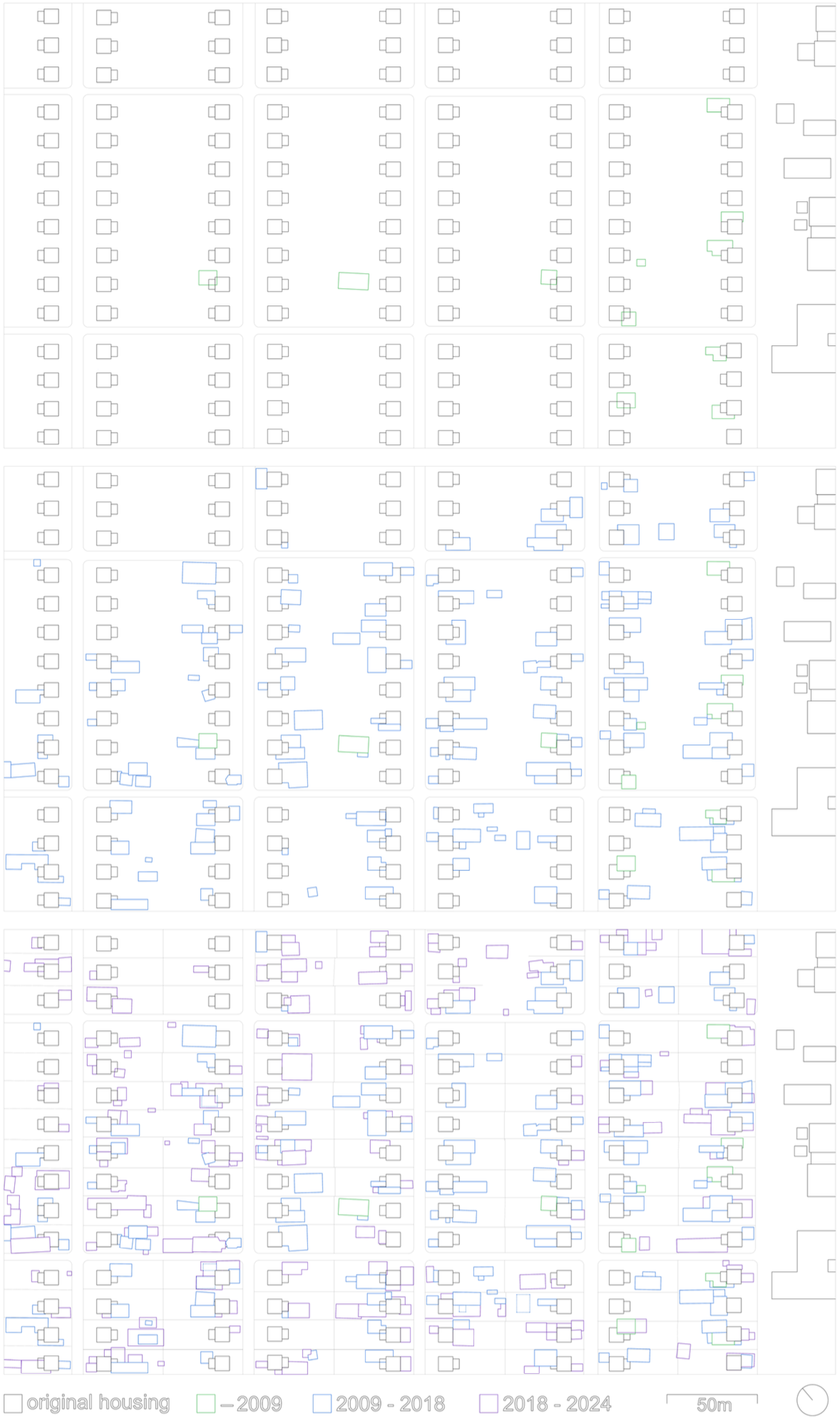
Musonoi's informal development can be seen as a built expression of the atomised nature of the forces involved in this new boom in development. Some time recently, Musonoi has been walled off following its sale as a concession. The delay in the relocation of its population is possibly due to the mining company's near suspension last April (Reuters 2024). Once a fully formed worker town, Musonoi is now difficult to access. The drive to Musonoi takes you through the Gécamines copper processing plant, a huge and complex network of corrugated sheet roofs and steel beams stripped of their materials. In the neighbourhood, houses have expanded into the street through informal incremental building. In the centre of the neighbourhood a market has formed. In the market, young men sit on motorbikes, wrapped in thick coats and adorned with cowboy hats. They are creusers, artisanal miners, in search of wealth in the form of cobalt and copper, which they mine with anything they can. As we drove in, two or three men climbed the fence that walls off the huge open-pit mine that abuts the neighbourhood, as a COMMUS security guard watched disinterestedly not twenty metres away.
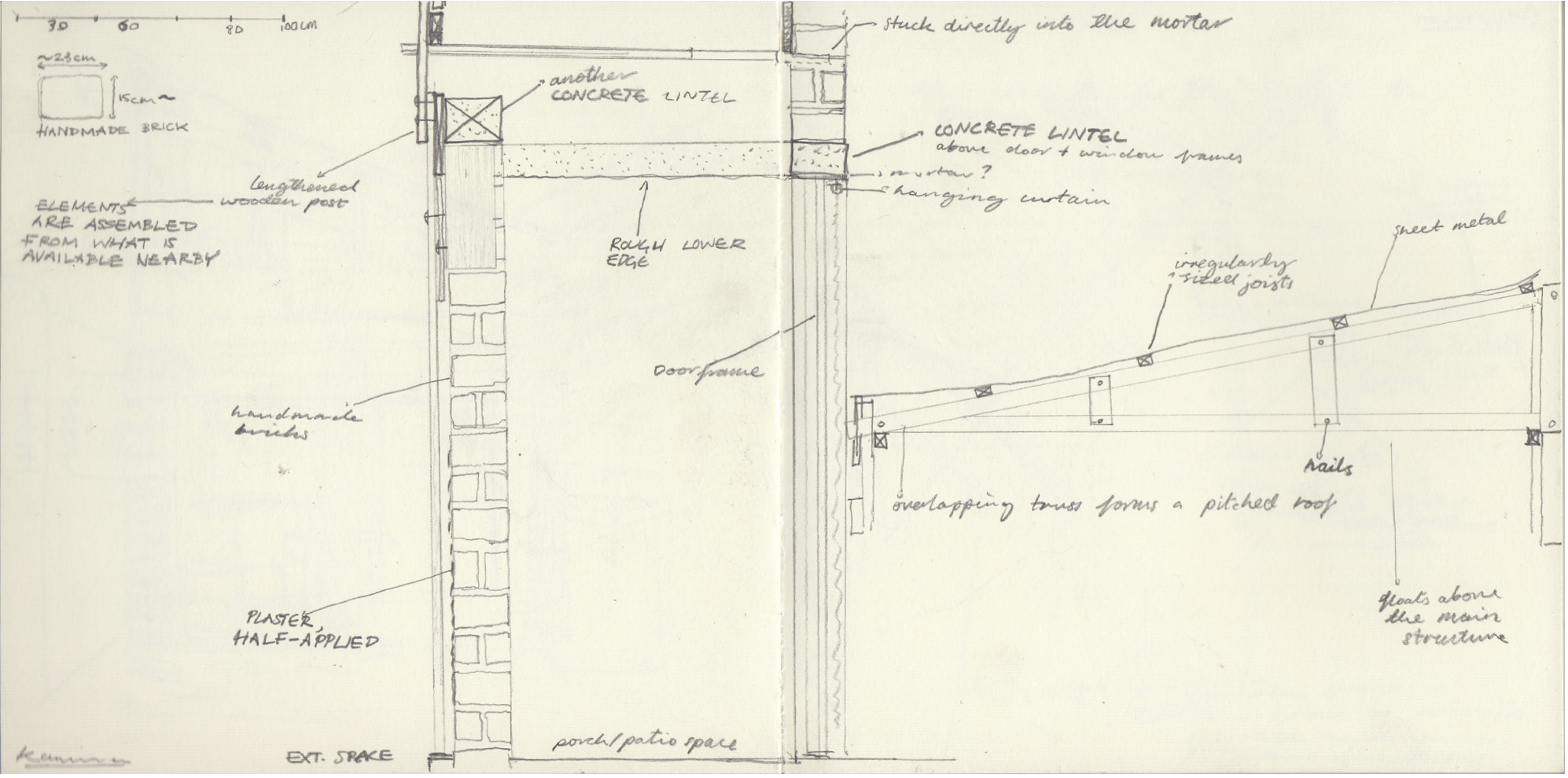
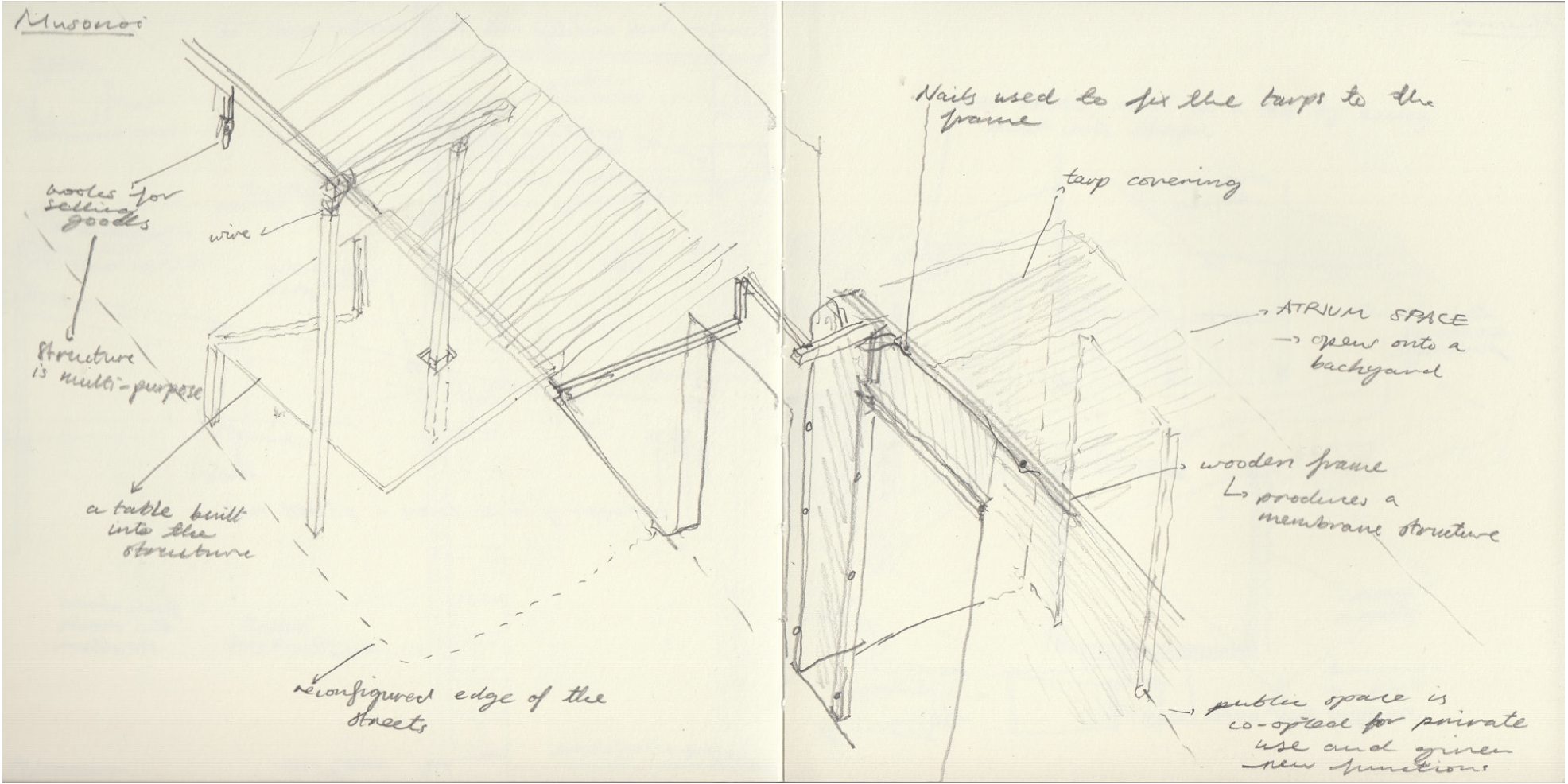
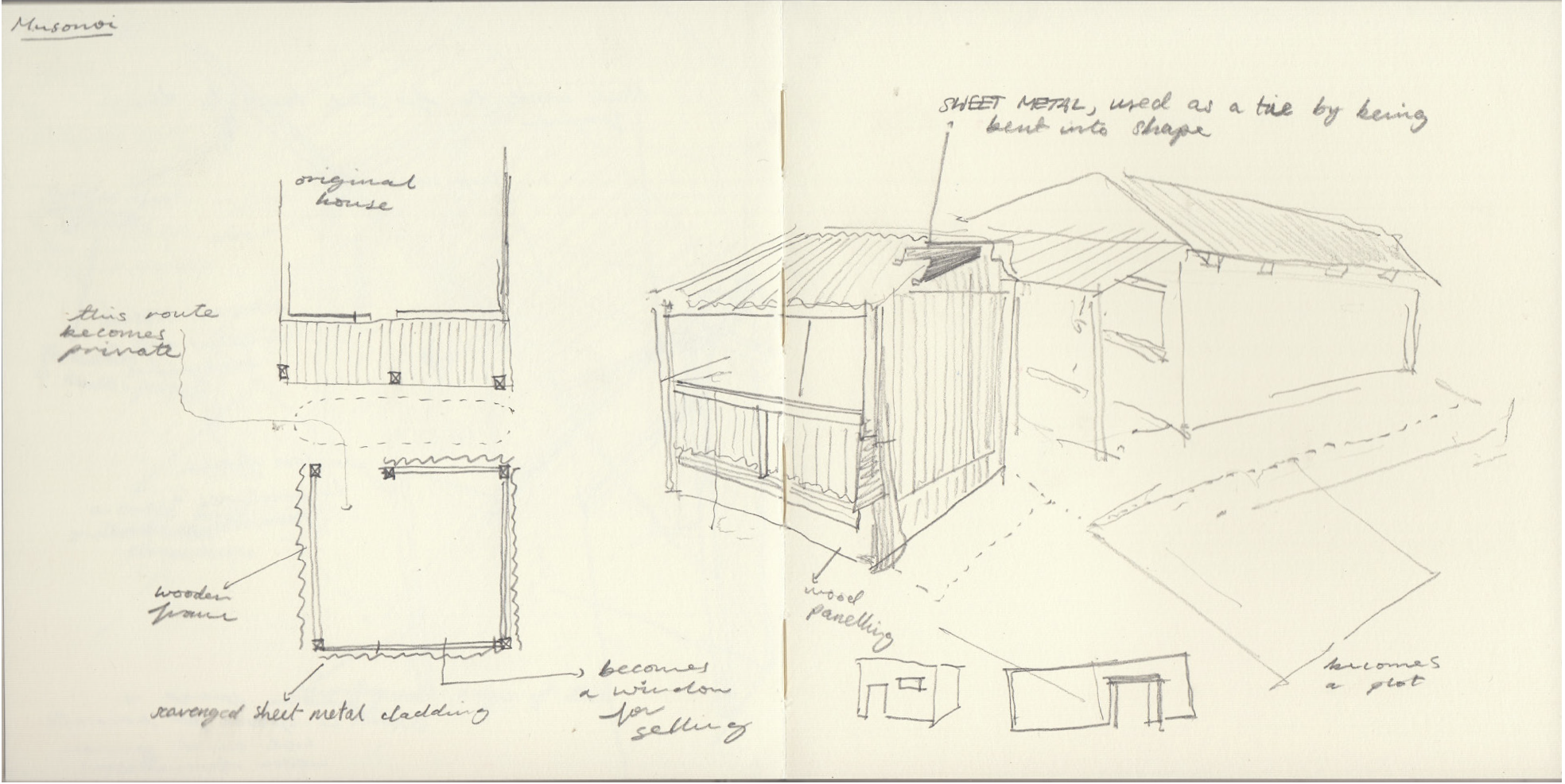
Musonoi is a site of ruination, its infrastructure completely degraded. Simultaneously, its architecture reveals a 'vital refiguration', an ongoing process in which 'inert remains' are co-opted by residents (Stoler 2013:10); for example, the decommissioned UMHK copper plant is scoured for materials that end up in the construction of new houses or repairs in the neighbourhood — tarps, sheet metal, steel bars and timber are all collected and reused.
Michel de Certeau draws a distinction between strategies — the domain of institutions, order and spatial control — and tactics, the improvised, opportunistic maneuvers of those operating within those structures (De Certeau 1984). In general terms, 'micro-scale morphologies and adaptations of formal settlements remain understudied' (Iranmanesh 2025:2). Musonoi's informal constructions, read as tactics, become a necessary response to a wider condition of precarity. Inhabitants become the practitioners of a type of urban growth that must be hyper-responsive, as 'the sequence of causation is suspended in the urgency of a moment where recklessness may be as important as caution' (Simone 2004:4). Since artisanal miners know they will likely have to move, the rational response is to build in a temporary fashion. In this way, informal adaptation comes to represent 'people's agency[…] in dealing with uncertainty and transition' (Marais et. al. 2021:75).
Informal labour housing has a logic of temporality that extends from the smallest juncture to large parts of new neighbourhoods. Interface creep (the tendency of incremental urban growths to move the public-private interface outwards) has narrowed the streets of the neighbourhood, but also creates the opportunity for direct interaction with the street frontage. Reconfigured edges create interactions and opportunities for selling, giving rise to Musonoi's roadside market, whose roofs imbricate themselves under or over the original.
For ASM workers, increasingly often socially dislocated young men or migrants in search of a windfall, the ability to move is an asset, and their temporary approach to building becomes a rational decision in a place whose future is unstable. ASM often necessitates spatial risk taking: 'artisanal miners often [leave] designated mines in which they worked purely based on rumours about booming mines elsewhere' (Makori 2017:791). These individual architectural endeavors reveal personal approaches to the city and its opportunities.
5. Contingency
Whilst the incremental urbanism observable at Musonoi is a productive mode of growth governed by rational spatial choices, the question of longevity remains. In addition, these rational choices, made on the small scale, paradoxically produce slum-like conditions, where neighbourhoods are somehow less than the sum of their parts. As the urban theorist AbdouMaliq Simone writes, 'adaptation or accommodation is not essentially what the society is, or is capable of becoming' (Simone 2004:2). Stuck in a precarious state of becoming, Kolwezi's informal settlements become increasingly developmentally stagnant.
For the young men who are creusers, individual spatial tactics grounded in the ability to quickly leave may seem a necessity when seemingly beleaguered by complex and fundamentally opaque systems of governance. The country's land laws have entrenched the possibility of this destruction. The Loi Foncière of 1973 on General Property, Land and Real Estate claims all land as the property of the state; although leases and use rights can be transferred, the state maintains the capacity to reclaim land.3 Since the 2002 Mining Code prioritised mining over other land use rights, the government allows current uses to be revoked or reassigned when it sells mining permits to companies.
Cultivating land and informal use is normally run on a de facto tenure, in which the inhabitants do not own the land and are leasing the houses, or are occupying illegally but in a way which is typically respected by custom. In the nearby city of Lubumbashi, this kind of land occupation 'became accepted practice [...] its use engendered respect and acknowledgement by other residents, and prevented encroachment or "takeover bids"' (Tambwe 2011:398). Almost the entire population lacks land documents in Kolwezi (Ngongo and Mutwale 2015); simultaneously, the lack of planning and weak enforcement of zoning laws means that mining zones are overlapping with residential areas in the centre of the city. This demonstrates the vulnerability of many areas and their legal inhabitability.
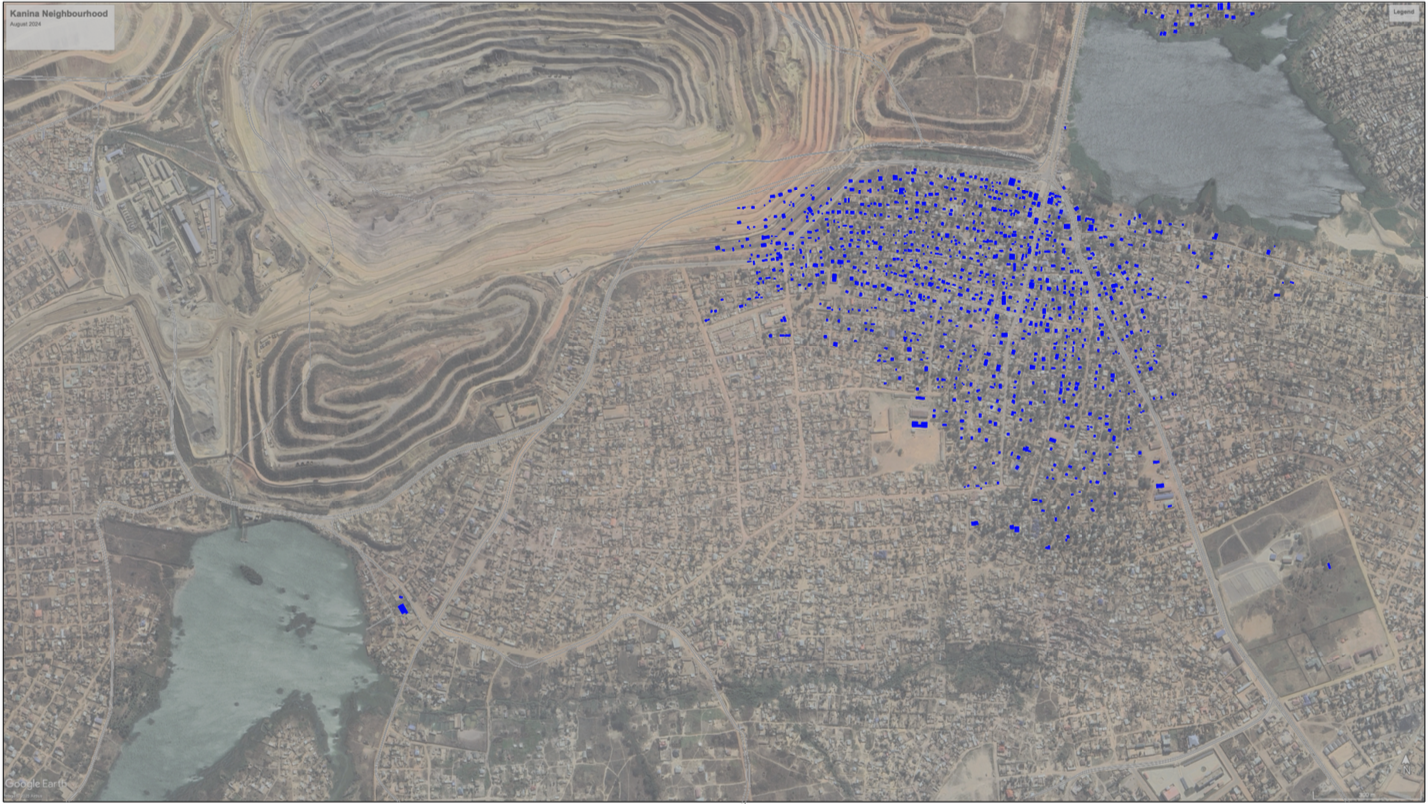
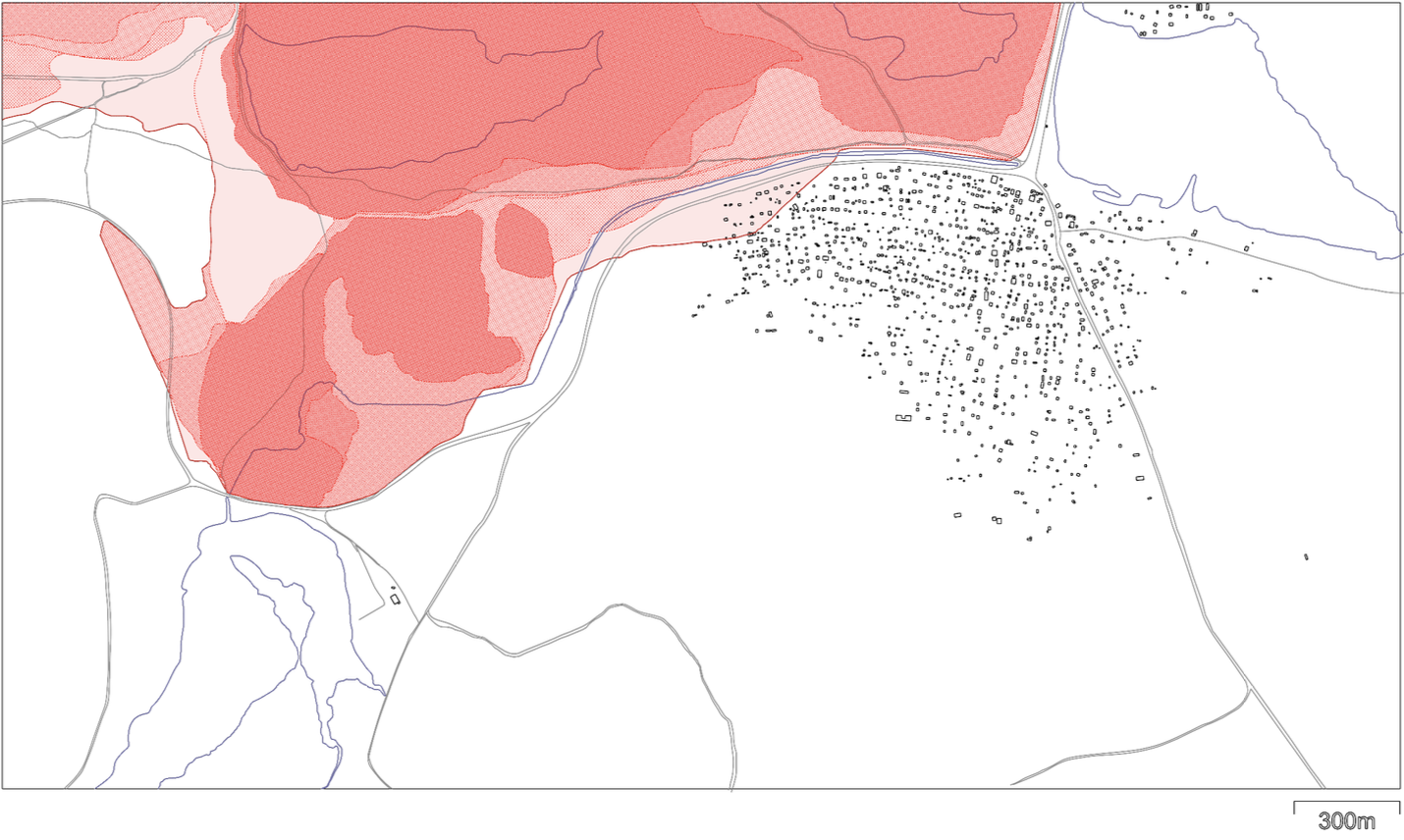
If mining has been the progenitor of the town, the orchestrator of its haphazard polynuclear model, it is equally responsible for its destruction. At the edge of the expansion of the COMMUS mining pit, it is possible to observe houses built and destroyed in the same year. Central neighbourhoods like Musonoi risk continuing their paradoxical oscillation between explosive development and frightful destruction until mining companies move on from the town and cobalt is no longer useful, or until the minerals run out.
- In fact, it seemed to be common knowledge in Kolwezi that creusers prefer private companies to own the rights to the land they're occupying, being more likely to carry out compensation than the government. ↩
The Modern Camp: Enclaves and Interaction
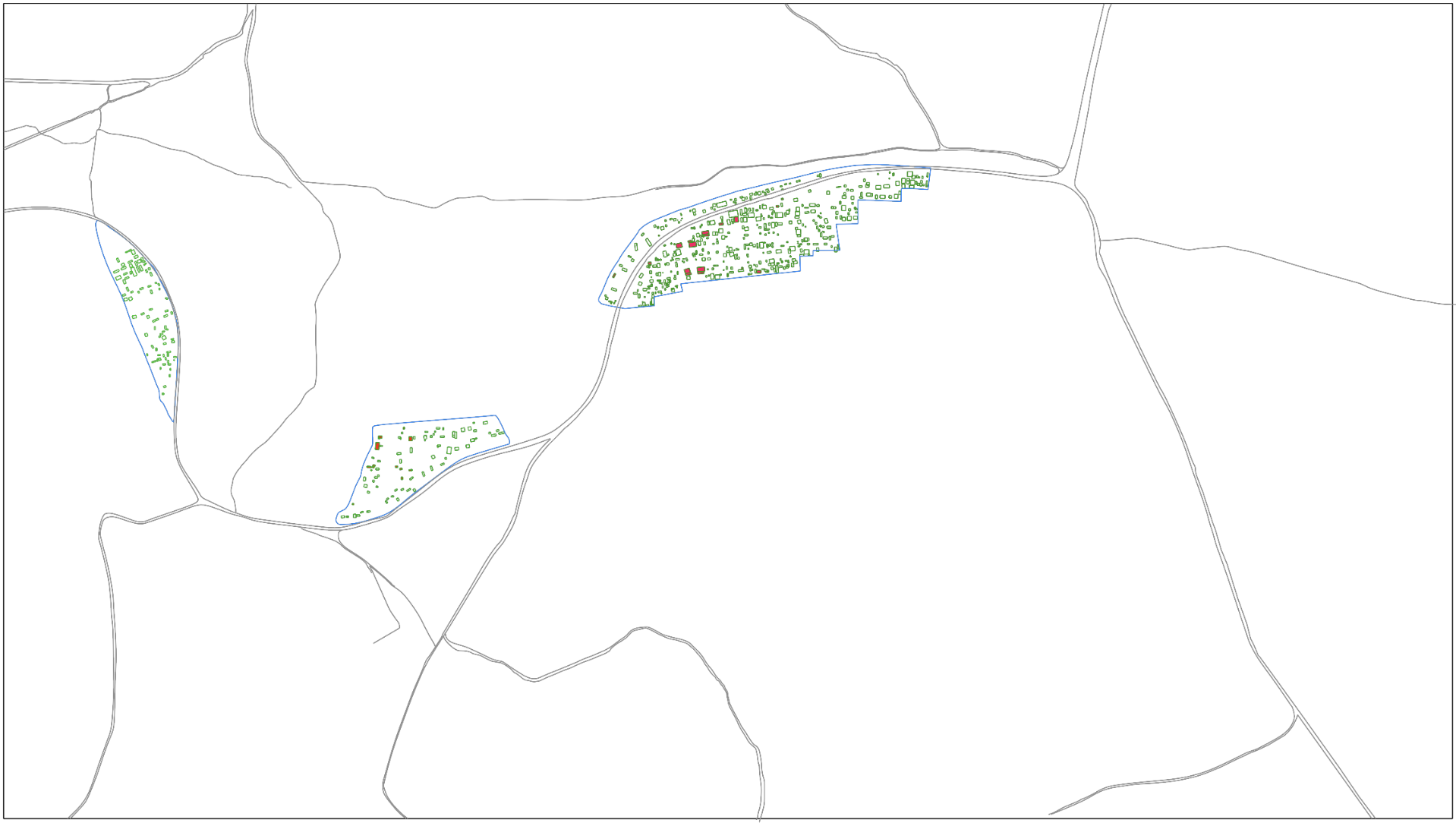
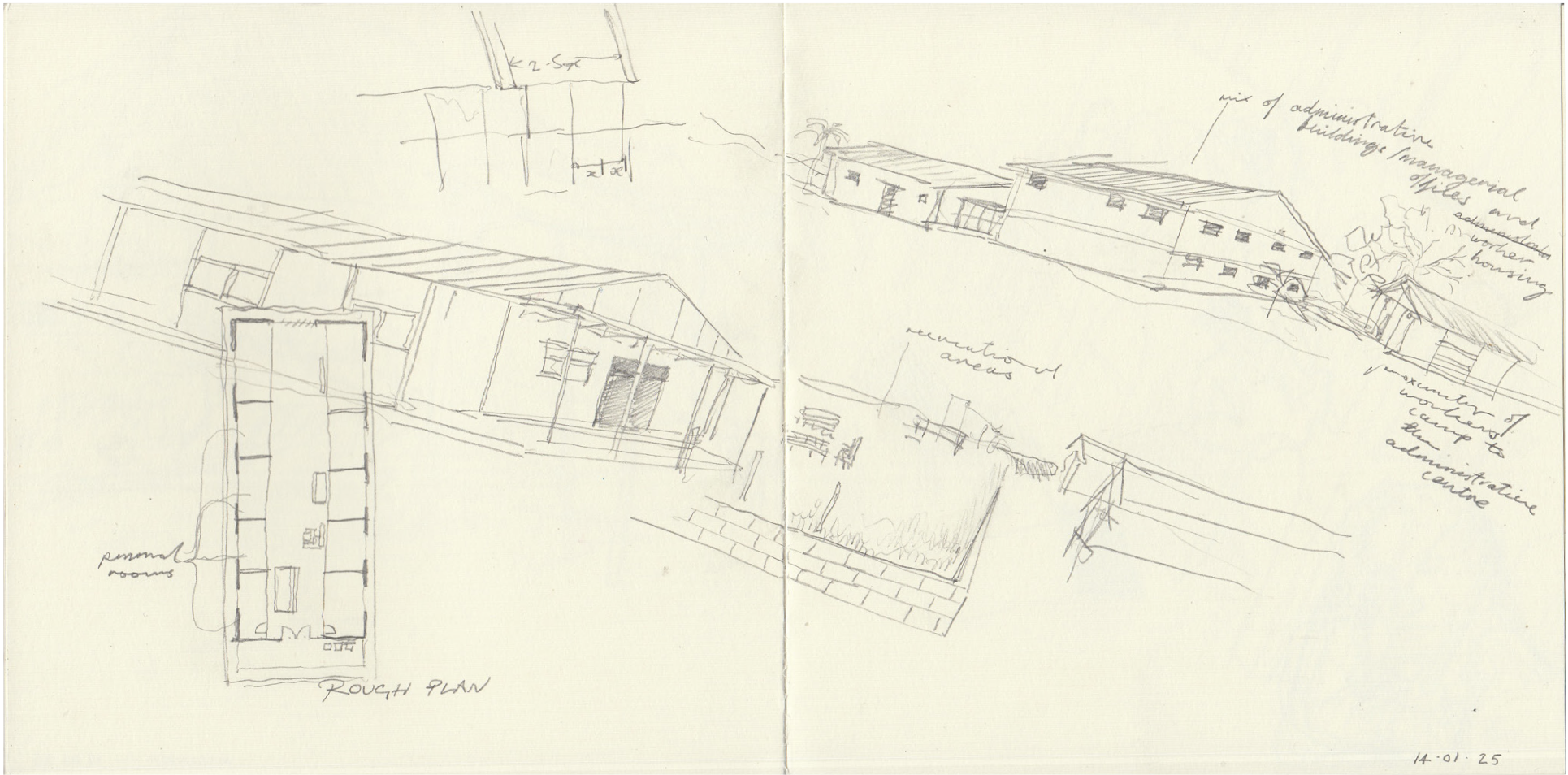
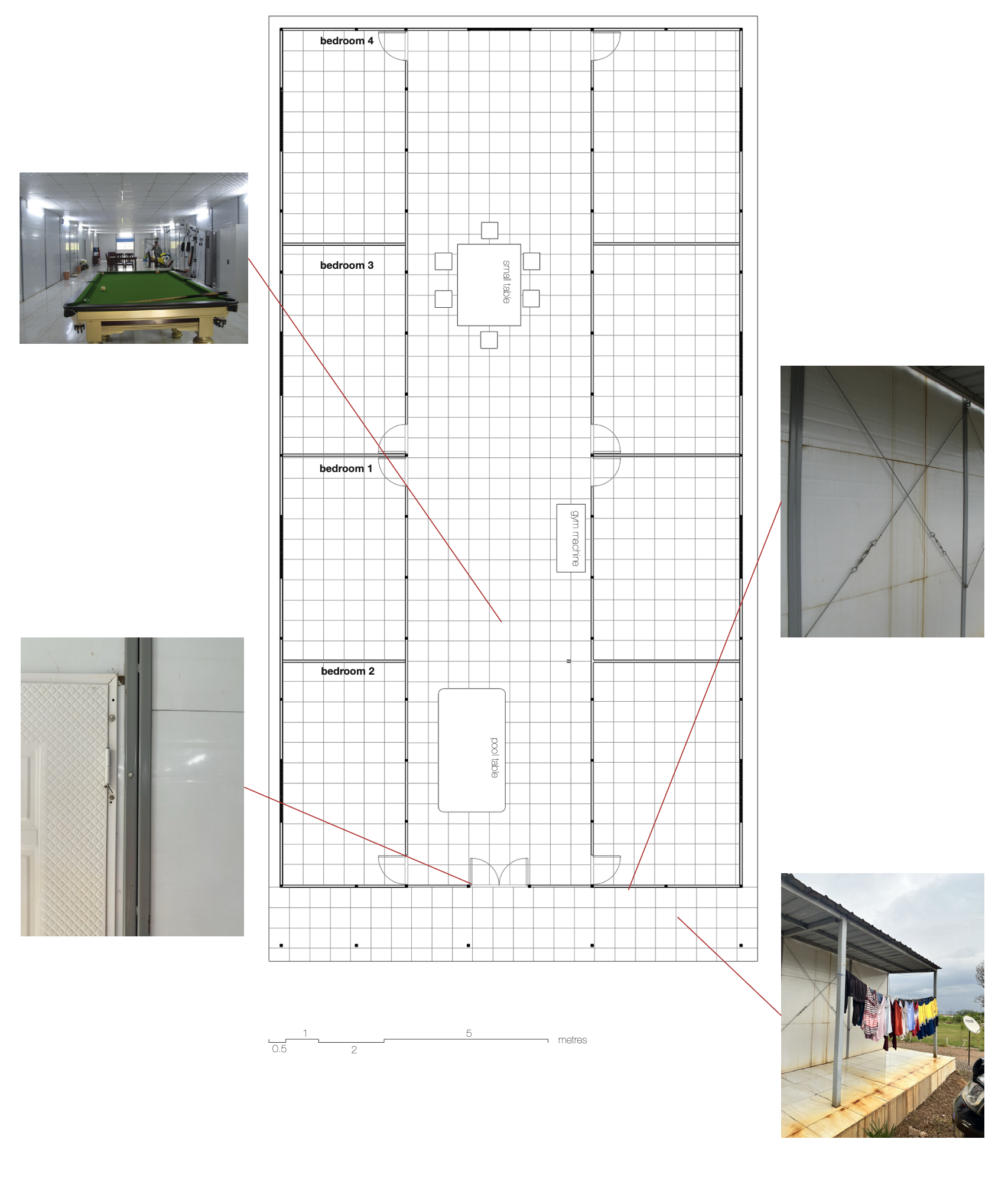
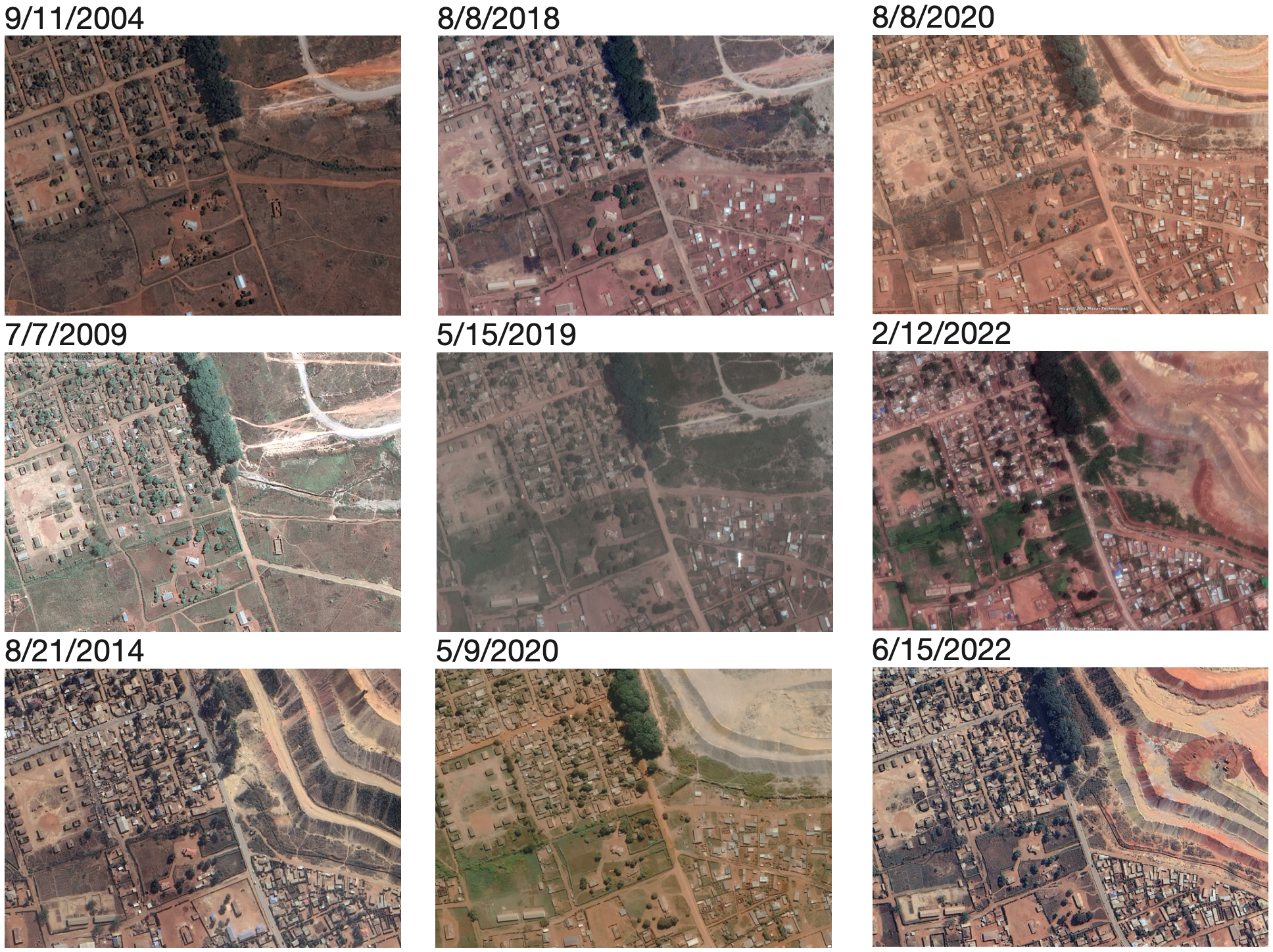
Musonoi's present day condition suggests that the development of labour housing in the city centre is mainly carried out by atomised individuals. The modern camp, by comparison, is governed by the force of international companies. Yet these companies themselves seem to act as individual entities divorced from the social fabric of the city. This is revealed through the modern approach to labour camps, which are built in the architectural language of the temporary.
To what extent can these new camps be characterised as 'mineral-rich enclaves that are starkly disconnected' from their local societies (Ferguson 2007:41)? The anthropologist James Ferguson argues that the non-spatial 'flow' of capital allows discrete points on the globe to be connected; global enterprises are able to cross the globe without 'encompass[ing] or cover[ing] contiguous geographic space' (Ferguson 2005:379).
The narrative of the securitised enclave is compelling, and in a precarious urban context, companies often prefer to take isolationist positions. In the context of mining's dependency on finite resources, the characterisation of the mining industry as a trou noir (black hole) into which wealth disappears without contributing to local development seems very plausible (Marysse and Tshimanga 2014).
Nevertheless, the diverse array of companies and approaches makes it harder to treat the mining industry as a monolith. Implementing specific case studies reveals a range of approaches, clouding this picture of spatial isolation. Although 'corporate power strategies are no longer concentrated in the single locus of the camp', they often 'operate through more flexible devices that entangle mining companies in multiple (local) spaces' (Rubbers 2019:94). The evolution of spatial tactics discussed in the case of Musonoi are themselves examples of such spatial entanglements, the consequences of ASM, which often forms such a crucial substratum of the labour supply (World Bank 2008).
The presence of these mineral trading posts in the city encourages inner city artisanal mining, which has spatial side-effects. An example of this in Kolwezi is Salongo Avenue, where 'miners, traders, street vendors of various goods, fortune seekers, women and children seeking paid employment, [and] porters and transporters' all congregate (Itumbo and Ngwej 2015:768). Through these entanglements, companies fail to enclave themselves from the city; ASM's role in the supply chain elucidates a symbiotic relationship, which is changing inner-city spaces. Another example is the case of the Kasulo neighbourhood: the incidental discovery of a rich seam of cobalt led to a fever of digging that ultimately resulted in its sale as a concession and a mass eviction of its residents (Ngogo and Mutwale 2015). There is also the danger of the literal undermining of one another, as residents wake to the sounds of tunnels being dug underground, threatening to collapse their houses (Geenen 2020).
Another spatial effect of new mining operations is illustrated by the nebulae of new villages on the boundaries of mining concessions and the fringes of workers camps. After work at one Kamoa camp, for example, employees sometimes go to an informal settlement that borders the mine to have drinks or engage in social activities.4 Consequently, informal settlements can be seen as secondary spaces of the built environment of the camp, forming part of the support system for workers. The labour housing of two different case studies, Kisanfu mine and Kamoa Kakula mine, informs an understanding of companies' approaches to space.
1. Kisanfu
Kisanfu is a relatively small mine. The lifespan of the known mineral deposits at Kisanfu is around fifteen years, though further prospecting could change this. The newly built labour housing is made of reusable metal sheets with concrete foundations, and structural steel frames. They use lightweight thermocol insulation panels which are easy to install, don't require skilled labour and are largely prefabricated, essentially requiring clipping together and drilling. Housing lifespan is also fifteen years or longer when treated with anti-corrosive paint. Concrete is produced locally which makes its use relatively cheap. Whilst cheaper methods of construction are available, it is the company's aim to disassemble and reuse these houses at another site. The use of prefab avoids any interaction with local economies. This illustrates a logic of temporality, de-emphasising lifespan as a construction consideration.
The plans of the newest worker housing on the site suggests an attention to detail in terms of producing pleasant working atmospheres; various activities have been provided for catering to social needs of workers. Within the camps themselves, they provide services and social infrastructure: two football fields, a medical dispensary and a dining hall. Unused space is granted to employees for agricultural use in a de facto tenure system.
CSR responsibilities have engaged Kisanfu with the urban fabric. The company fulfills these obligations through the Vinmart Foundation, a subcontracting arrangement that creates a distance between the practice of urban development and the management; the mine manager was aware of one hospital, two schools, and some 'small bridges' that have been built in the area, but wasn't sure where they were.
40% of the employees who live in the camps take buses to work every day, arranged by the company, from nearby villages: like at many other mines, the rest are internal migrants who come from Lubumbashi or other nearby villages to come and work for a period of 25 days before returning home. Employees who work for long periods and are found to be trustworthy are invited to stay for longer durations in the camps. This job creation also affects spaces in and around the town, as people seek permanent housing; 31.4% of the formal workforce of the region of Haut-Katanga and Lualaba were employed by the mining sector as of 2011, likely significantly higher in a mining city like Kolwezi fourteen years later (UN 2011).
2. Kamoa Camp
Kamoa-Kakula is a project by Ivanhoe Mines, in partnership with Zijin Mining. It is 'the world's fastest-growing, highest-grade, and lowest-carbon emitting' copper mine, set to become the second largest in the world (Ivanhoe Mines Website n.d.).
Workers at Kamoa are housed in several different camps, the largest of which is Kamoa camp, a separate site near the mine. The Kamoa site is vast, and practically constitutive of a town in its own right. The site is made up of dozens of different companies and camps; cement producers, logistics, underground mining activities and quarries all have their own compounds. Housing for workers varies depending on the sub-contractors and companies responsible for their building, and in many cases is ranked by employee level: low-level employees often live in tents or fabric housing, whilst managerial living quarters are more sturdy.
In the examples I saw, all were subject to the requirements of easy disassembly. Some labour housing was made of simple tents set in a grid in a small compound. Washing lines were strung outside each tent so that employees could dry their clothes. Inside, there were only beds. This housing was for shift workers who live in the compounds on a temporary basis. In contrast, housing at the Kamoa base camp was made from plastic-injected sheet moulds, which was prefabricated and assembled on site. The shared quality of all the labour housing at Kamoa was sheer utility and flexibility. Almost all the housing I saw could be reused. That which couldn't be reused was made from metal panels attached to a steel frame. If it couldn't be reused, it was made as cheaply and quickly as possible.
Whilst the camps present different situations, they share an approach of impermanence and utilitarianism towards on-site labour housing. In essence the modern camps are utilitarian worlds to a fault. They are in the language of the temporary.
Whilst at Musonoi, UMHK had embedded labour in a system in an attempt to monitor the process; the new camps seem to have a more hands-off approach to their employees and to their surrounding environment. In some way, the architecture of the labour camp today is unconcerned with any stabilisation or moralisation; it is a secular enterprise whose approach to planning is decided on a rationalist profit-maximising basis. Prefabricated houses at both mines are used because their disassembly is possible, and the mines themselves may move. The production of new camps is done with the knowledge that ultimately all will be abandoned. Labour housing is once again seen as a temporary provision.
This attitude towards labour housing, and indeed the sentiment behind such a view, seems more comparable to the early days of UMHK's spatial approach to labour than to the corporate paternalism of the 70s. The spatial problem for mining companies today is how to draw labourers from long distances in order to work at the mines. In this way the conception of labour has somehow once again become de-spatialized, able to indulge in an ignorance towards the connection between labour and space. The view of labour as a fictitious commodity has returned.
Whilst mining companies do have spatial consequences, the spatial interaction mining companies are engaged in today are almost completely disconnected from the spatial tool of the camp. Permanent housing is left to the free choice of the employee, on the grounds of practicality, but also, in some cases, a feeling of futility (one mine manager said the following: 'the state does not want the people to wake up').
At both camps, I observed small satellite settlements near the concession, mostly occupied by farmers and coal salesmen, but also some labourers. It is the suspicion of these companies that these settlers are there for the purpose of receiving displacement compensation. This emboldens the idea of the contingency of urban development on mining companies. Kamoa Kakula is expected to have a mine life extension of 42 years. When this life expectancy is reached and the compounds are dissolved, how developed will these surrounding settlements be? The spatial side effects of the fractured labour regime today are distinctive; labour is atomised and disembedded, moving to find work. Will these unorthodox patterns of growth affect the viability of the permanence of Kolwezi's contemporary development?
- Personal observation. ↩
Continuity More Than Change
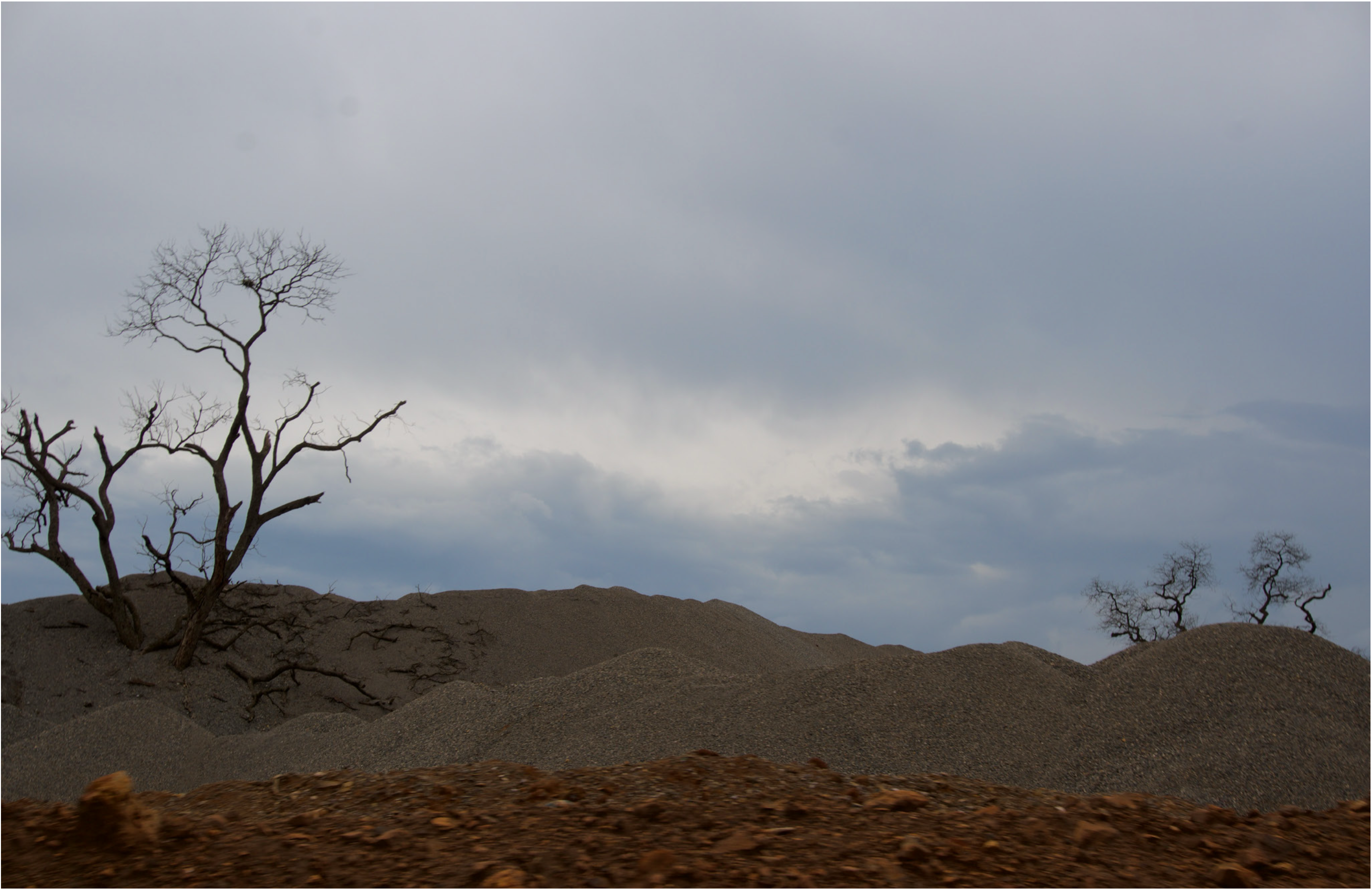
'Let corn flow like water, and it will find its level.'
John Arbuthnot, 1773.'Copper is like water here, you know.'
Logistics worker, Lubumbashi, 2025.Ultimately, 'the relationship between minerals and development is a precarious one: rich soils do not unavoidably lead to better lives' (Geenen 2020:16). The Musonoi neighbourhood has transformed from a crystallisation of urban control to an archaeology of informal interventions. The market is not just reflected but metabolised and enacted through the spaces of the city, through the individual tactics of atomised workers but also through the approach of international companies to the spaces of the city. In this way, the formation and development of spaces becomes subordinated to market forces.
In a moment of symmetry, labour housing has returned to a system more similar to the early days of UMHK. Labour housing has once again become an exercise in logistics, more divorced from the city and its growth than before the reforms of the 2000s. The informal nature of Kolwezi's development is an expression of the conditions of urban growth created by the mining company's isolationist approach to urban planning and design, and then more significantly, the subsequent withdrawal of the company from social life in the 1970s and 80s. In addition, the spatial legacy Gécamines left behind has influenced perceptions of a shared past which has led to the emergence of the conceptualisation which is still used today as a metric for judging modern housing arrangements. In essence, 'the paternalistic policy implemented by Gécamines in the past continues to raise [workers'] material and social expectations' (Rubbers 2017:201).
Through a chronological analysis of labour housing spaces in Kolwezi across multiple scales, a pattern of recursive growth emerges. The relationship between the mining industry and its labour housing reveals a recursive logic of impermanence, a kind of urban development that is both a temporary and extractive project. As a result, inhabitants are involved in unorthodox patterns of growth through informal settlements, stuck in a stage of 'becoming' that does little to aid long-lasting development. Simultaneously and in a double movement, the mining industry is destroying large areas of the city in order to mine.
Tracing the genealogy of labour housing spaces suggests that, whilst the modern city is growing as it did before, the continued contingency of this growth on the presence of mining companies undermines its spatial stability. Whilst the old corporate paternalism had exercised a spatial means of control on its workers through labour housing, this at least enabled the development of meaningful urban spaces. In contemporary labour housing, there is no plan at all.
'The Kolwezi public works and infrastructure department' has had 'no capital budget since 1990', essentially removing its ability to 'undertake any public infrastructure projects in the city'. Kolwezi has thus become dependent on the 'largesse' of mining companies (Mthembu-Salter 2009:15). The 'dependency on non-renewable mineral resources imparts a distinct form of temporality', a problem magnified without sufficient state apparati to reap long-lasting spatial development (Bryceson and MacKinnon 2012:517). As natural landscapes are replaced by anthropogenic ones, will the city be able to develop the necessary mechanisms required for sustaining urbanity when the mining industry leaves (Muteya et. al. 2022)? As the city develops for a second time, will it be able to overcome the condition of contingency and overreliance on a single industry that first made it vulnerable to collapse in the 1990s?
Whilst the first bust of Kolwezi's mining industry was ultimately tied to a series of national crises, the enclaved approach of contemporary mining companies suggest that another bust is plausible. It is true that global mineral demand is creating changes on the scale of the country, the city, and the neighbourhood. International infrastructure projects like the Lobito corridor, which will connect Kolwezi to the Angolan port city of Lobito; a new, second airport for the city is under construction, and whole neighborhoods are moving South. Yet infrastructures for commodities have no purpose if the commodities become purposeless. Rapidly changing technologies and the move towards cobalt-free batteries increase the chance of Kolwezi becoming another abandoned industrial town.
Equally, there are other sites that provide opportunities for mineral extraction in the Congo. The Congo has over 1,100 identified minerals in its substrate; as green technologies shift, previously unimportant minerals may gain relevance, as has happened with cobalt. The changing market could lead to a new bust; an example of movements at a global scale which trample the spatial tactics of the local. An example of this is the Manono-Kitolo mine, an old mine in the neighbouring province of Tanganyika. In 2018, the largest lithium spodumene deposit in the world was discovered there. The rights to the Manono-Kitolo mine have already been auctioned off by Gécamines. As ethical and geopolitical concerns over cobalt increase, a move towards lithium-only battery technologies might cause cobalt's value to dramatically fall (Patton 2022).
This research has invited further questions about the nature of sustainable development, and examines the spatial interaction of global capital flows and the spaces they operate in. I have attempted to provide a 'way in' for further study of the social and spatial implications of mining's labour housing and the legacy it leaves in Kolwezi and in Katanga. Kolwezi speaks profoundly of precarity, which I have tried to allude to or indicate throughout the chapters of this dissertation. The city is caught in a balancing act, and the uncertain future of Kolwezi seems caught between 'digging deeper' or 'moving on'. (Bryceson and MacKinnon 2012:532).
Bibliography
- Amnesty International. 2016. This Is What We Die For: Human Rights Abuses in the Democratic Republic of the Congo Power the Global Trade in Cobalt. London: Amnesty International.
- Arbuthnot, John. An Inquiry into the Connection Between the Present Price of Provisions, and the Size of Farms. London: J. Dodsley, 1773.
- Atibu, Emmanuel K., et al. 2013. 'Concentration of metals in surface water and sediment of Luilu and Musonoie Rivers, Kolwezi-Katanga, Democratic Republic of Congo.' Applied Geochemistry, 39, pp. 26–32.
- Banjikila Bakajika, Thomas. 1993. 'Capitalisme, rapport salarial et regulation de la main-d'oeuvre: la classe ouvrière noire dans les camps de l'eUnion Minière du Haut-Katanga, 1925–1967.' Ph.D. diss., Université de Laval.
- Birchard, Ralph E. 1940. 'Copper in the Katanga Region of the Belgian Congo.' Economic Geography, vol. 16.55 no. 4, pp. 429–36.
- Bruneau, Jean-Claude, and Mansila Fu-Kiau. 1989. 'Des corons aux villages neufs: le retour à la terre en périphérie de Kolwezi (Zaïre)'. La péri-urbanisation des les pays tropicaux. Bordeaux: Presses Universitaires de Bordeaux.
- Bruneau, Jean-Claude, and Shourit Mansila Fu-Kiau. 1986. 'Kolwezi: L'Espace Habité et ses Problèmes dans le Premier Centre Minier du Zaïre.' Cahier des Sciences Humaines 22(2): 217–29.
- Bryceson, Deborah, and Danny MacKinnon. 2012. 'Eureka and Beyond: Mining's Impact on African Urbanisation.' Journal of Contemporary African Studies 30(4): 513–37.
- Büscher, Karen. 2018. 'Urbanisation and the Political Geographies of Violent Struggle for Power and Control: Mining Boomtowns in Eastern Congo.' In African Cities and the Development Conundrum, 302–24. Leiden: Brill.
- Calvão, Filipe. 2011. 'When Boom Goes Bust: Ruins, Crisis and Security in Megaengineering Diamond Mining in Angola.' In Engineering Earth: The Impacts of Megaengineering Projects, edited by Stanley D. Brunn, 367–82. New York: Springer.
- Certeau, Michel de. 1984. The Practice of Everyday Life. Berkeley: University of California Press.
- De Boeck, Filip. 2022. 'Suturing the (W)hole: Vitalities of Everyday Urban Living in Congo.' In Grammars of the Urban Ground, 150–63. Durham, NC: Duke University Press.
- De Meulder, Bruno. De kampen van Kongo: arbeid, kapitaal en rasveredeling in de koloniale planning. Amsterdam: Meulenhoff; Antwerpen: Kritak, 1996.
- Dibwe dia Mwembu, Donatien. 1990. Industrialisation et Santé: La Transformation de la Morbidité et de la Mortalité à l'Union Minière du Haut-Katanga, 1910–1970.
- Dibwe dia Mwembu, Donatien. 2001. Bana Shaba Abandonnés par leur Père: Structures de l'Authorité et Histoire Sociale de la Famille Ouvrière au Katanga 1910–1997. Paris: L'Harmattan.
- Dilsaver, Lary M. 1985. 'After the Gold Rush.' Geographical Review 75(1): 1–18.
- Dovey, Kim, et al. 2023. Atlas of Informal Settlement: Understanding Self-Organized Urban Design. London: Bloomsbury Publishing.
- Ferguson, James. 2005. 'Seeing like an oil company: space, security, and global capital in Neoliberal Africa.' Am. Ethnol. 107(3), 377–382.
- Ferguson, James. 2006. Global Shadows: Africa in the Neoliberal World Order. Durham, NC: Duke University Press.
- Financial Times. 2024. 'The US-Backed Railway Sparking a Battle for African Copper.' Financial Times, August 21, 2024.
- Foucault, Michel. Discipline and Punish: The Birth of the Prison. Translated by Alan Sheridan. 2nd Vintage Books ed. New York: Vintage Books, 1995.
- Geenen, Kristien. 2021. 'Gnawing Away at the City: Narratives of Domestic Precarity in a Congolese Mining Town.' African Studies Review 64(2): 412–33.
- Geenen, Kristien. 2024. 'How Industrial and Artisanal Extraction Shape a City: On Urban Planning Flaws, Encroaching Open Pits and Backyard Mining in a Congolese Mining Town.' In The Global Life of Mines: Mining and Post-Mining in Comparative Perspective, 90–112. New York and Oxford: Berghahn Books.
- Henk, Daniel Wallace. 1985. Kazi Ya Shaba: Choice, Continuity, and Social Change in an Industrial Community of Southern Zaire. PhD diss., University of Minnesota.
- Higginson, John. 1989. A Working Class in the Making: Belgian Colonial Labor Policy, Private Enterprise, and the African Mineworker, 1907–1951. Madison: University of Wisconsin Press.
- Home, R. K. 2000. 'From Barrack Compounds to the Single-Family House: Planning Worker Housing in Colonial Natal and Northern Rhodesia.' Planning Perspectives 15(4): 327–47.
- International Crisis Group. 2020. 'A Tale of Three Sites.' In Mineral Concessions: Avoiding Conflict in DR Congo's Mining Heartland, 11–17. International Crisis Group.
- Iranmanesh, Aminreza, and Hesam Kamalipour. 2025. 'Towards a Configurational Typology of Informal Settlements: A Syntactic Analysis of Informal Settlements in Nagpur.' Journal of Urban Affairs.
- Itumbo, Michel Matuka Ngoy, and Jean-Jacques Diur Ngwej. 2015. 'De la gestion des eaux et des espèces végétales face à l'exploitation des comptoirs miniers à Musompo.' KAS African Law Study Library 3: 759–76.
- Ivanhoe Mines. n.d. 'Kamoa-Kakula Mining Complex.' Accessed April 9, 2025.
- Katz, Irit. 2022. 'Introduction: The Common Camp.' In The Common Camp: Architecture of Power and Resistance in Israel–Palestine, 1–22. Minneapolis: University of Minnesota Press.
- Kara, Siddharth. 2022. Cobalt Red: How the Blood of the Congo Powers Our Lives. New York: St. Martin's Press.
- Larmer, Miles, and Rachel Taylor. 2021. 'The Decolonisation of Community Development in Haut-Katanga and the Zambian Copperbelt, 1945–1990.' In Across the Copperbelt, 321–46. Woodbridge, UK: Boydell & Brewer.
- Lombaerde, Piet, and Krista De Jonge, eds. 2011. Early Modern Urbanism and the Grid: Town Planning in the Low Countries in International Context. Turnhout: Brepols.
- Makori, Timothy. 2017. 'Mobilizing the Past: Creuseurs, Precarity and the Colonizing Structure in the Congo Copperbelt.' Africa: Journal of the International African Institute 87(4): 780–805.
- Marais, Lochner, et al. 2022. 'Informal Settlements in the Mining Context.' In Coal and Energy in South Africa: Considering a Just Transition, 73–87. Edinburgh University Press.
- Marysse, Stefaan. 2012. 'La renaissance du secteur minier en RDC: Une analyse socio-économique.' In L'Afrique des Grands Lacs: Annuaire 2011–2012, 173–202. Paris: L'Harmattan.
- Marysse, Stefaan, and C. Tshimanga. 2014. 'Les "trous noirs" de la rente minière en RDC.'
- Mouchet, R., and Arthur Pearson. 1923. The Practical Hygiene of Native Compounds in Tropical Africa. London: Baillière, Tindall & Cox.
- Mthembu-Salter, Gregory. 2009. 'Natural Resource Governance, Boom and Bust: The Case of Kolwezi in the DRC.' South African Institute of International Affairs.
- Mukhija, Vinit. 2001. 'Upgrading Housing Settlements in Developing Countries: The Impact of Existing Physical Conditions.' Cities 18(4): 213–22.
- Mususa, Patience Ntelamo. 2014. 'There Used to Be Order: Life on the Copperbelt after the Privatisation of the Zambia Consolidated Copper Mines.' Master's thesis, University of Cape Town.
- Muteya, Héritier Khoji, et al. 2022. 'Quantification and Simulation of Landscape Anthropization around the Mining Agglomerations of Southeastern Katanga (DR Congo) between 1979 and 2090.' Land 11(6): 850.
- Ngongo, Jean-Marie, and Didier Mutwale. 2015. 'La problématique d'octroi et de la gestion des terrains et concessions minières par les Divisions des Affaires Foncières et Cadastre Minier dans le District Urbano-Rural de Kolwezi.' KAS African Law Study Library 2: 693–717.
- Noorani, K. Emilio. 2025. 'What's Happening in the Congo Right Now?' Emilio in Congo (DRC). March 19, 2025.
- Patton, Kelsey Dallas. 2022. 'Elon Musk and His Success with a Cobalt-Free EV Battery at Tesla.' Deseret News, May 6, 2022.
- Perrings, Charles. 1979. Black Mineworkers in Central Africa: Industrial Strategies and the Evolution of an African Proletariat in the Copperbelt, 1911–41. New York: Africana Publishing.
- Polanyi, Karl. 2001. The Great Transformation: The Political and Economic Origins of Our Time. Boston: Beacon Press.
- Reuters. 2024. Reports on COMMUS mining near-suspension. April 2024.
- Rubbers, Benjamin. 2017. 'Mining Towns, Enclaves and Spaces: A Genealogy of Worker Camps in the Congolese Copperbelt.' Geoforum 98: 88–96.
- Rubbers, Benjamin. 2019. 'Mining Boom, Labour Market Segmentation and Social Inequality in the Congolese Copperbelt.' Development and Change 51(6): 1–22.
- Rubbers, Benjamin. 2021. Mining Capitalism: The Relationship between Corporations, Households and Industrial Labour in the Congolese Copperbelt. Oakland: University of California Press.
- Simone, AbdouMaliq. 2004. For the City Yet to Come: Changing African Life in Four Cities. Durham, NC: Duke University Press.
- Stoler, Ann Laura. 2013. Imperial Debris: On Ruins and Ruination. Durham, NC: Duke University Press.
- Tambwe, N. 2011. 'Etat, acteurs privés et gestion des ressources minières en RDC.' In L'Afrique des Grands Lacs: Annuaire 2010–2011, 385–406.
- Thompson, E. P. 1993. Customs in Common: Studies in Traditional Popular Culture. New York: New Press.
- UMHK. 1956. Union Minière du Haut-Katanga 1906–1956. Brussels: L. Cuypers.
- Van Nitsen, R. 1933. L'hygiène des travailleurs noirs dans les camps industriels du Haut-Katanga. Brussels: Institut Royal Colonial Belge.
- Vwakyanakazi, Mukohya. 1988. African Traders in Butembo, Eastern Zaire. PhD diss., University of Wisconsin-Madison.
- Walker, P. 2016. 'Islands of Health: Architecture and the Development of Colonial Public Health in the Belgian Congo.' Unpublished manuscript.
- World Bank. 2007. DRC Growth with Governance in the Mining Sector. Washington, DC: World Bank.
- World Bank. 2008. Democratic Republic of Congo: Growth with Governance in the Mining Sector. Washington, DC: World Bank.